Google Wants Gemini to Be the Default Computer Before Apple Can Reframe the Story
Google's Android Show preview was not just a feature dump. It was a platform signal that Gemini is moving from app assistant to ambient execution layer across phone, laptop, and car.

Listen to this post
Google just showed its hand before I/O, and I think the message is more aggressive than the polished demos make it look.
This was not a routine Android feature preview. It was Google telling the market that Gemini is graduating from assistant feature to default computing layer.
Phone, laptop, car. Same direction. Same pitch. The operating system is becoming an intelligence system.
That matters because platform winners do not just ship better models. They make their model the place where user intent gets resolved by default.

Googlebook is the clearest tell
The weirdest announcement in the set is also the most revealing.
Googlebook, if it ships anywhere close to what Google previewed, is not just a new laptop brand. It is Google's attempt to define a laptop around Gemini-native interaction instead of treating AI as a sidebar bolted onto ChromeOS.
The details matter here. Magic Pointer is basically context-sensitive intent resolution at the cursor. Create your Widget turns Gemini into a layout and workflow orchestrator. Quick Access pulls phone files and apps into the laptop surface without forcing the old sync dance.
None of that sounds revolutionary if you read it one feature at a time. Together, it does.
Google is trying to collapse the distance between noticing context and acting on it. That is the real product move. If the cursor, desktop, file system, and app layer all become input channels for Gemini, then the laptop stops being a place where you launch tools and starts becoming a place where the system continuously helps complete tasks.
For builders, the important question is not whether every first-generation interaction will feel great. Some of them probably will not. The important question is whether Google is planting Gemini deep enough in the stack that third-party products will have to assume ambient AI mediation as a default condition.
Android Auto pushes the same strategy into the car
The car update makes this even harder to dismiss as branding.
Google is not just putting a voice assistant in the dash. It is extending context-aware task handling into a place where the interface has to be more predictive, more constrained, and more system-level.
Gemini in Android Auto now handles message context, suggested replies, food ordering, and in-car assistance. In cars with Google built-in, it goes deeper by reasoning over vehicle-specific state. That is the important escalation.
Once the model can answer questions about your actual dashboard light, your cargo space, your current route, your media state, and your next errand, the assistant stops being a chat endpoint. It becomes operational middleware.
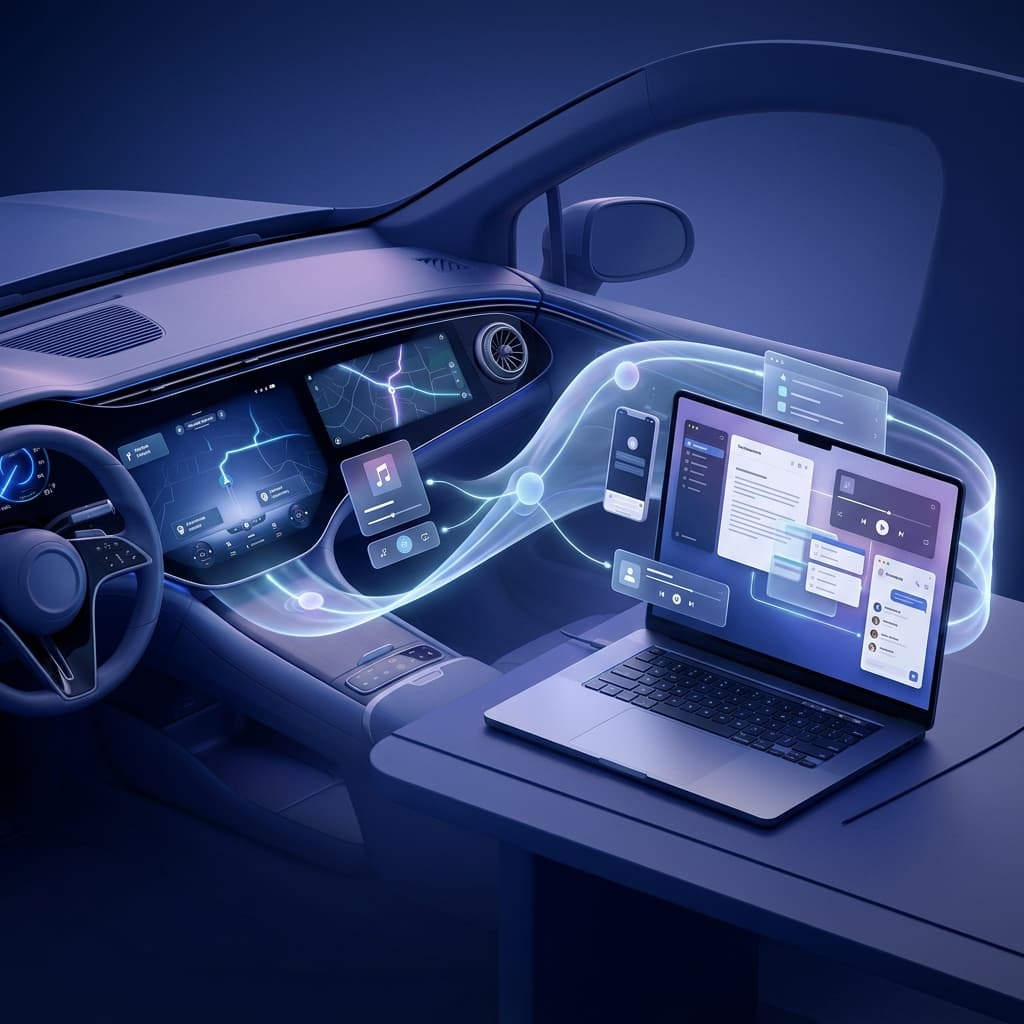
That is what I think Google wants across the whole ecosystem. Not a smarter app. A persistent reasoning layer with enough permissions and context to intercept workflows before you consciously route them yourself.
Apple should take that seriously, because the car is one of the few places where default behavior matters more than model personality.
Android 17 for creators fits the same playbook
The creator features look smaller, but they fit the same strategic pattern.
Screen Reactions, AI enhancements in Meta's Edits app, Instagram pipeline optimization, and Premiere on Android tablets all point toward one idea: the phone should not merely capture and publish content. It should compress the distance between raw material and finished output.
Again, the key move is not the individual feature. It is the workflow consequence.
If Android can make capture, cleanup, enhancement, posting, and cross-device continuation feel like one continuous action path, Gemini does not need to scream for attention. It just becomes the system that keeps momentum alive.
That is a much stronger moat than a chatbot icon.
This is a preemptive narrative strike on Apple
CNBC framed this correctly even if the official announcements stay diplomatic: Google is racing to put Gemini at the center of Android before Apple gets its next clean shot at the AI story.
I think that is exactly right.
Apple still has distribution power, hardware loyalty, and the ability to reset public perception with one polished platform message. Google knows that. So instead of waiting for I/O or reacting after WWDC, it is trying to flood the zone with evidence that Gemini already lives everywhere that matters.
Phone context. Laptop context. Car context. Creator workflow. Ambient action.
The goal is simple: by the time Apple talks, Google wants the market to already accept that the default model for personal computing is continuous AI mediation across surfaces.
That does not require every product to win on first contact. It requires the narrative to harden before Apple can soften it.
My builder takeaway
If you build apps, tools, or internal systems on Android-adjacent surfaces, I would stop thinking about Gemini as a destination and start treating it as infrastructure.
The question to ask now is not "should we add AI". It is "what happens when the operating environment starts pre-processing user intent before our product even gets the request?"
That changes interface design, permissions strategy, handoff patterns, and where differentiation lives.
Google's Android Show preview was not subtle. The company is trying to make Gemini the ambient default across the personal computing stack before Apple can reframe the conversation.
I do not think builders should treat that as hype. I think they should treat it as a platform warning.
Sources: Googlebook announcement, Android in cars updates, Android 17 creator features, CNBC context