Google I/O 2026 Is Where AI Stopped Talking and Started Acting
Google used I/O 2026 to make one thing clear: the next AI fight is not just about who has the best chatbot. It is about who can turn search, software, and everyday intent into supervised action at scale.

Listen to this post
Google did not spend I/O 2026 trying to prove it can build a better chatbot.
It spent I/O trying to prove something more important: that AI is moving from conversation to execution.
That is the real story underneath the flood of announcements.
Google put agents directly into Search. It made Gemini 3.5 Flash the default model inside AI Mode. It started turning the search box into an intent router that can monitor, synthesize, book, call, and even generate mini-app style interfaces on the fly.
That is a much bigger strategic shift than another model launch.
The search box is no longer just a place to ask
Reuters caught the commercial angle quickly: Google is trying to blunt Anthropic and OpenAI with a faster, cheaper model and by pushing agents directly into its biggest consumer surface.
That matters because Search is still Google's distribution weapon.
Plenty of labs can ship a strong model. Very few can drop that model inside a product used by billions and then wrap it around real user intent, live data, and transaction paths. Google's own Search team called this the biggest upgrade to the Search box in more than 25 years, and for once that does not sound like marketing fluff.
The redesign is strategic. The box expands, takes multimodal input, keeps conversational context, and starts acting less like a query field and more like an orchestration layer. If that sticks, the center of gravity moves away from "AI chat" and toward "AI operating surface."
Search agents are the clearest tell
The most revealing announcement was not visual. It was behavioral.
Google is launching information agents that sit in the background, reason across the web and fresh data sources, and notify users when conditions change. Apartment hunting, price watching, sports drops, travel, local services, and booking flows all fit the same pattern: the user states intent once, then the agent keeps working.
That is a major product transition.
Chatbots answer. Agents persist.
Once Search can monitor, revisit, synthesize, and route users back only when something meaningful happens, Google stops competing only on answer quality. It starts competing on delegated follow-through.
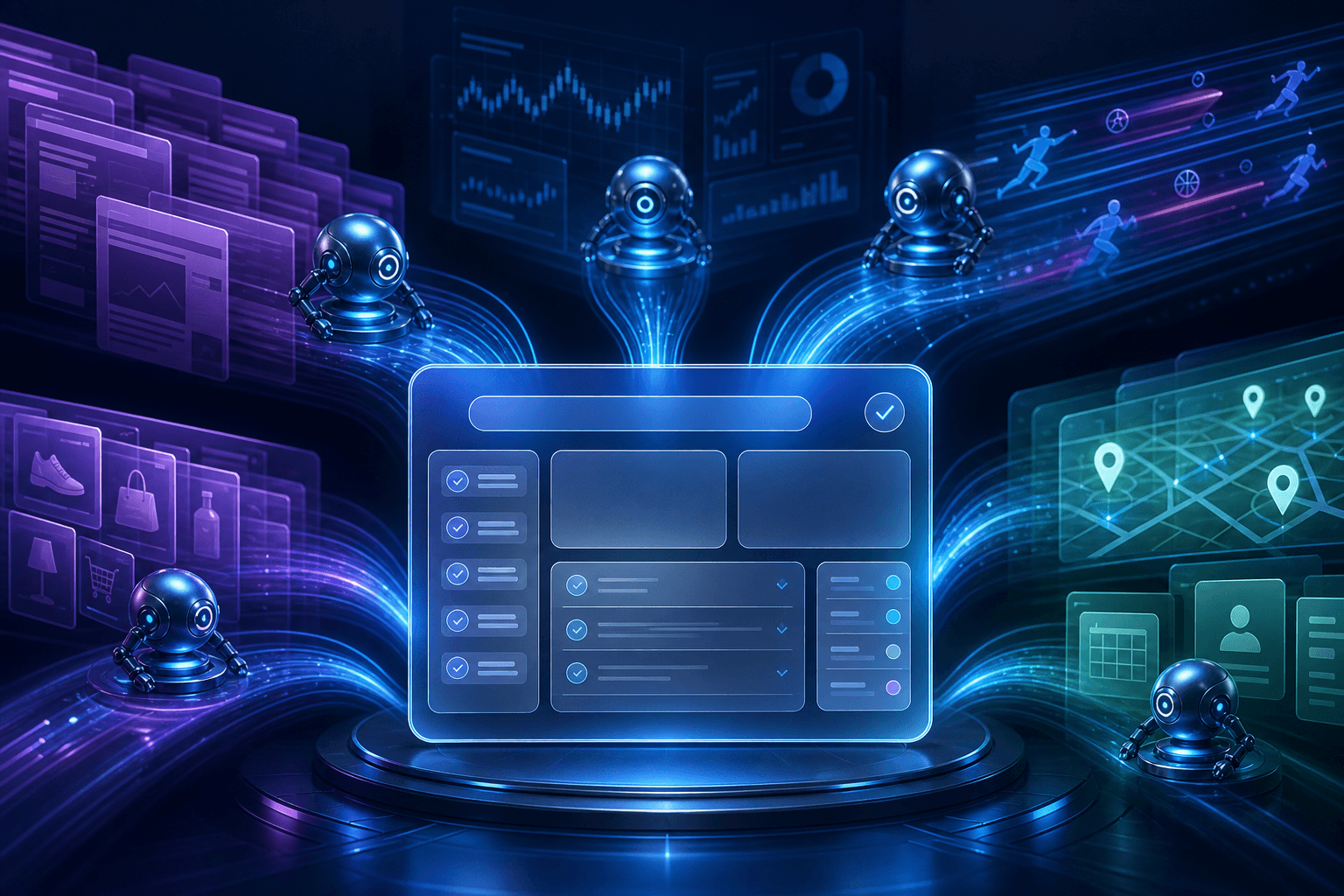
For builders, this changes the design question. The old question was, "How do we add an assistant?" The new one is, "What happens when the platform keeps the task alive after the user leaves?"
That has implications for lead generation, commerce, scheduling, local search, customer acquisition, and any workflow that used to depend on a human repeatedly re-running the same query.
Gemini 3.5 Flash is the economic engine under the strategy
The model news matters, but mostly because of what it enables.
Google says Gemini 3.5 Flash is built for agentic workflows, coding, and collaborative subagents. The company claims frontier-level performance with much lower latency, plus materially lower cost than rival frontier models. Reuters reported Google leaned hard into that pricing message, with Sundar Pichai arguing companies could save enormous amounts by switching and with Google cutting AI Ultra pricing while also adding a new $100 tier aimed at developers and work-heavy users.
This is not just a benchmark flex. It is infrastructure positioning.
If Google wants Search agents, coding agents, enterprise agents, and personalized agents all running continuously, the model underneath has to be cheap enough and fast enough to make always-on behavior economically sane. That is why 3.5 Flash matters. It is the model that makes agentic product design easier to ship at scale.
The Google blog makes that explicit: 3.5 Flash is now the default in AI Mode, available in Search, the Gemini app, Antigravity, AI Studio, Android Studio, and enterprise agent products. The same model family is being pushed across consumer, developer, and enterprise surfaces at once.
That is not a feature rollout. That is stack consolidation.
Google is turning Search into an app generator, not just an answer engine
The mini-app angle deserves more attention than it is getting.
Google says Search can now assemble custom generative UI, including interactive visuals, tables, graphs, simulations, trackers, and recurring dashboards built on the fly for specific tasks. In plain English, Search is moving beyond returning links or summaries and toward generating lightweight software experiences in context.
That is a serious escalation.
Instead of sending users away to a product, Google can increasingly instantiate a thin version of the product inside Search itself. For some categories, that will feel magical. For publishers, SaaS tools, and marketplaces, it should also feel a little threatening.

If your business depends on being the destination after discovery, pay attention. Google is making a bid to collapse discovery, decision support, and lightweight execution into one surface.
My blunt read
I/O 2026 is the moment Google's AI story became less about chat and more about action.
The search box is becoming an agent surface. Gemini 3.5 Flash is being positioned as the cheap, fast execution layer for that surface. And Google is using the only advantage most rivals cannot match at full scale: direct distribution into Search, plus enough product surface area to keep agents useful after the first prompt.
That does not mean Google automatically wins. Agents inside core products create trust, quality, and control problems fast. Users will punish flaky autonomy. Developers and businesses will resist if Google becomes too aggressive about swallowing downstream value.
But the direction is unmistakable.
The next phase of AI competition is not just who talks best. It is who acts usefully, cheaply, and often enough to become default behavior.
At I/O 2026, Google made it clear that this is the phase it wants to own.
Sources: Reuters, Google Search blog, Google Gemini 3.5 blog, Google developer highlights