Nvidia and Microsoft are turning the AI agent stack into a Windows hardware war
On June 1, 2026, Nvidia and Microsoft unveiled RTX Spark PCs and DGX Station for Windows. The real story is not just another chip launch. It is a push to move serious AI agents onto local machines, inside the operating system, and closer to enterprise workflows.
Listen to this post
Nvidia did not just announce a new chip on June 1, 2026.
It announced a new argument about where AI agents should live.
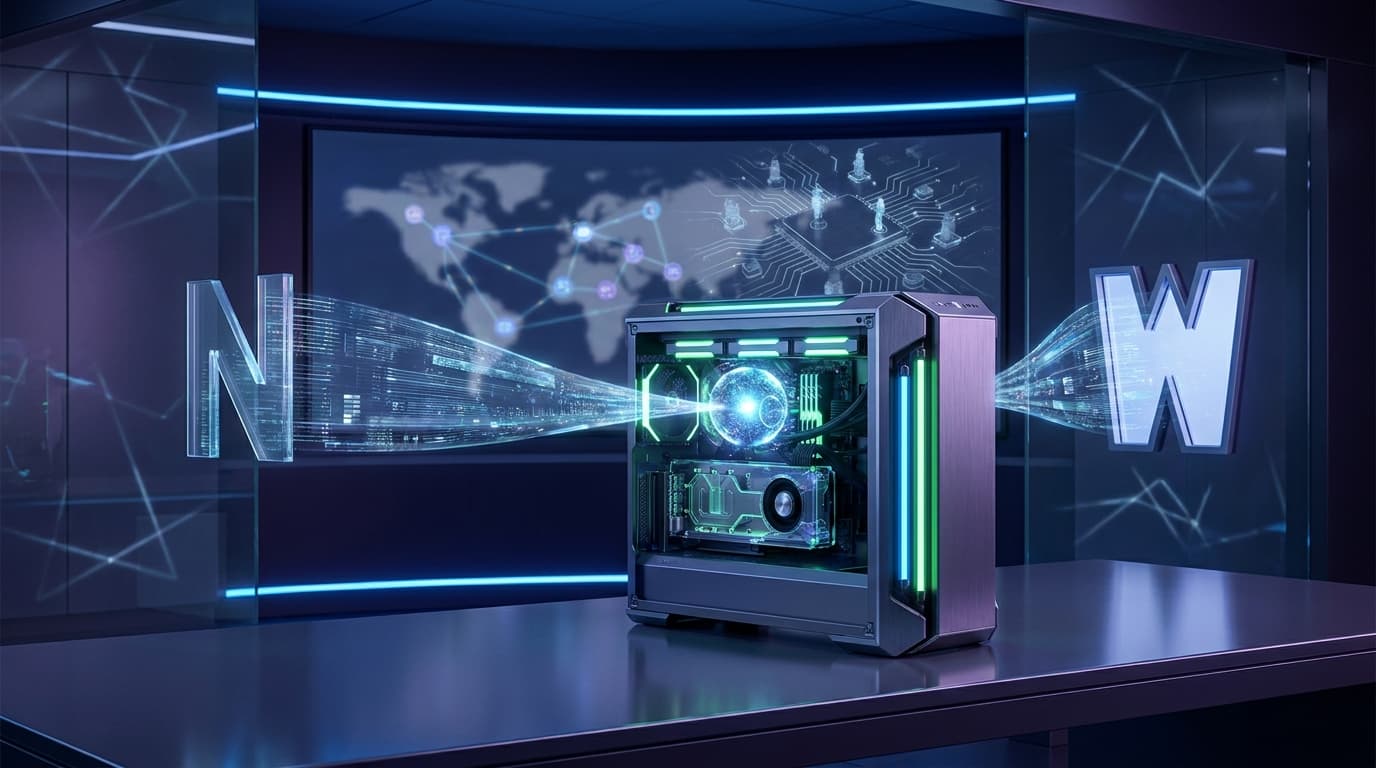
At Computex in Taipei, Nvidia and Microsoft unveiled RTX Spark, a new Windows PC superchip aimed at "personal AI" workloads, and paired that with DGX Station for Windows, a deskside system built to run far larger agent workflows locally. The official message was straightforward: the next AI computer should not behave like a thin client waiting on the cloud. It should run meaningful agent work on the device itself, inside the workflows people already use. (NVIDIA RTX Spark announcement, NVIDIA DGX Station for Windows announcement)
That is a bigger strategic move than "Nvidia enters AI PCs."
It is a bid to make Windows the operating environment for local agents, from laptops all the way up to enterprise deskside supercomputers.
What Nvidia and Microsoft actually launched
The consumer-facing piece is RTX Spark.
Nvidia says the chip delivers 1 petaflop of AI performance, up to 128GB of unified memory, and enough local capacity to run 120B-parameter language models with up to 1 million tokens of context, alongside creative and gaming workloads. The pitch is not just raw performance. It is that the PC becomes a place where agents can operate locally, securely, and persistently instead of bouncing every serious action back to a remote data center. (NVIDIA RTX Spark announcement)
The enterprise-facing piece is even more revealing.
DGX Station for Windows is supposed to bring data-center-class AI infrastructure onto the desk, with support for models up to 1 trillion parameters locally, up to 748GB of coherent memory, and enough throughput to run hundreds of agents in parallel. That turns the Windows machine from a terminal into a serious local agent host for engineering, research, design, and data work. (NVIDIA DGX Station for Windows announcement)
AP’s same-day reporting fills in the market context. Nvidia said machines from Microsoft, Dell, and other PC makers are expected later this year, while Jensen Huang framed the moment as a reinvention of the personal computer around autonomous assistants that can read files, do research, and help across normal work. (AP News)
Why this matters more than another chip cycle
For the last two years, most AI product strategy has assumed the center of gravity stays in the cloud.
That assumption is starting to break.
If agents need constant access to private documents, local applications, design tools, engineering environments, and user context, then sending every high-value action off-device becomes awkward. Latency becomes part of the product. Privacy becomes part of the product. Network dependence becomes part of the product. So does the problem of how much an agent can actually see and do inside a real workflow.
Local compute changes that equation.
It lets the machine hold more context, interact more directly with local state, and keep sensitive work closer to the operator. Reuters captured the broader competitive implication: Nvidia is pushing AI directly into personal computers, taking aim at Apple and Intel while betting that private edge agents will become a real category rather than a niche feature. (Reuters via Investing.com)

That does not mean the cloud stops mattering. It means the boundary changes.
The interesting future is not cloud or local. It is a split architecture where the device handles more agent state, more live context, and more first-party workflow control, while the cloud handles overflow compute, model updates, and larger shared systems. Nvidia and Microsoft are trying to own the local half of that stack before someone else turns the operating system into a dumb window for remote models.
This is really a control-plane fight
The most important line in Nvidia’s announcement was not the throughput number. It was the security and runtime story.
Nvidia and Microsoft are explicitly talking about native Windows agent experiences, new security primitives, and NVIDIA OpenShell as a secure runtime for autonomous agents. In the DGX Station announcement, Nvidia goes even further: it describes isolated sandboxes, system-level policy enforcement, and enterprise manageability as first-class pieces of agent deployment. (NVIDIA RTX Spark announcement, NVIDIA DGX Station for Windows announcement)
That is what a platform war looks like in 2026.
The winning stack may not be the one with the flashiest model benchmark. It may be the one that can answer harder operational questions:
- Where does the agent run?
- What can it touch?
- How does policy get enforced?
- Which apps and files can it understand natively?
- What happens when it moves from one user to one team to an entire enterprise fleet?
Those are operating-system questions as much as model questions.
What builders and enterprise teams should take from this
If you build AI products, the main takeaway is that "agent experience" is quickly becoming infrastructure-dependent.
A local agent that can reason over files, keep state near the user, connect into familiar applications, and operate under device-level policy is a different product from a browser tab wrapped around a remote model. The user may see both as "AI." Operationally, they are not the same thing.
For enterprise teams, this also sharpens procurement choices.
You are no longer only choosing a model vendor or a cloud vendor. You are starting to choose an endpoint architecture. Do you want agent work centered in the browser, the SaaS layer, the operating system, the workstation, or some mix of all four? Nvidia and Microsoft are making a strong case that the endpoint deserves to matter again.

That has second-order consequences too:
- security teams will care more about local containment and agent permissions
- IT teams will care more about fleet manageability for AI hardware
- software teams will care more about whether their tools expose enough local context for agents to be useful
- cloud providers will face more pressure to justify why a given workload should stay remote
My take
The important part of today’s Nvidia news is not that one more company wants a piece of the PC market.
It is that Nvidia and Microsoft are trying to define the AI computer as a system that hosts agents directly, not just a device that requests answers from somewhere else.
If that framing sticks, then the next AI battle is not only about who has the best model. It is about who controls the secure runtime, the local context, the application surface, and the handoff between personal machines and enterprise infrastructure.
That is a much more durable fight than a one-day keynote.
And it is one that could make Windows relevant to AI strategy in a deeper way than most people expected.
Sources: NVIDIA on RTX Spark and personal AI PCs, NVIDIA on DGX Station for Windows, AP News on Nvidia’s June 1 AI PC launch, Reuters on Nvidia pushing AI directly into PCs