Apple's WWDC26 AI bet is a local workflow platform, not a chatbot comeback
As WWDC26 opens on June 8, 2026, Apple's clearest AI signal is not just a delayed Siri fix. It is the company's push to make Apple Intelligence a developer platform built around on-device models, tool calling, visual intelligence, and workflow automation that stay close to the user.
Listen to this post
WWDC26 opened on Monday, June 8, 2026, with Apple explicitly promising AI advancements alongside new software and developer tools.
That matters, but not for the reason most coverage will emphasize first.
Reuters is right that Siri is the headline pressure point. Apple has spent two years carrying the cost of overpromising a smarter assistant, and the market wants proof that the company can close the gap. But the more important strategic signal is lower in the stack. Apple's public developer materials now center direct access to the on-device Apple Intelligence model, built-in guided generation and tool calling, visual intelligence that extends to the screen, and a Shortcuts layer that can route model output into real actions. (Apple Newsroom, Apple Developer, Apple Foundation Models updates, Reuters via Investing.com)
That is the real story of the day.
Apple is trying to turn AI from a feature narrative into a platform narrative.
Apple is telling developers to build with local intelligence, not just call an assistant
The clearest line on Apple's current developer site is also the most important one: developers now have direct access to the on-device foundation model at the core of Apple Intelligence.
That is not a cosmetic API.
Apple says the Foundation Models framework supports text extraction, summarization, guided generation, and tool calling, and that a Swift app can start using it with very little code. The documentation also highlights structured outputs, prompt versioning, runtime token counting, and tools that let the model call app-specific logic. In other words, Apple is no longer just exposing a branded assistant experience. It is exposing a local reasoning layer that developers can wire into existing software. (Apple Developer, Foundation Models documentation)
This is the correct move.
A lot of AI products still act like the main question is which assistant users will talk to.
That is not the durable question.
The durable question is which platform lets builders add intelligence closest to the workflow, with enough privacy and latency advantages that it can run continuously rather than occasionally.
Apple is finally arguing from that position.
The most interesting Apple Intelligence features are really action surfaces
The developer pages do not just talk about chatting with a model.
They talk about where intelligence can enter and leave the system.
Apple says visual intelligence now extends to the iPhone screen, not just the camera. It says App Intents can plug app search capabilities into that layer. It says Shortcuts now has a new Use Model action that can tap on-device or Private Cloud Compute responses and feed them into the rest of an automation. It also says developers can use Image Playground APIs and an Image Creator API directly inside app experiences. (Apple Developer)
That is much more important than another polished demo reel.
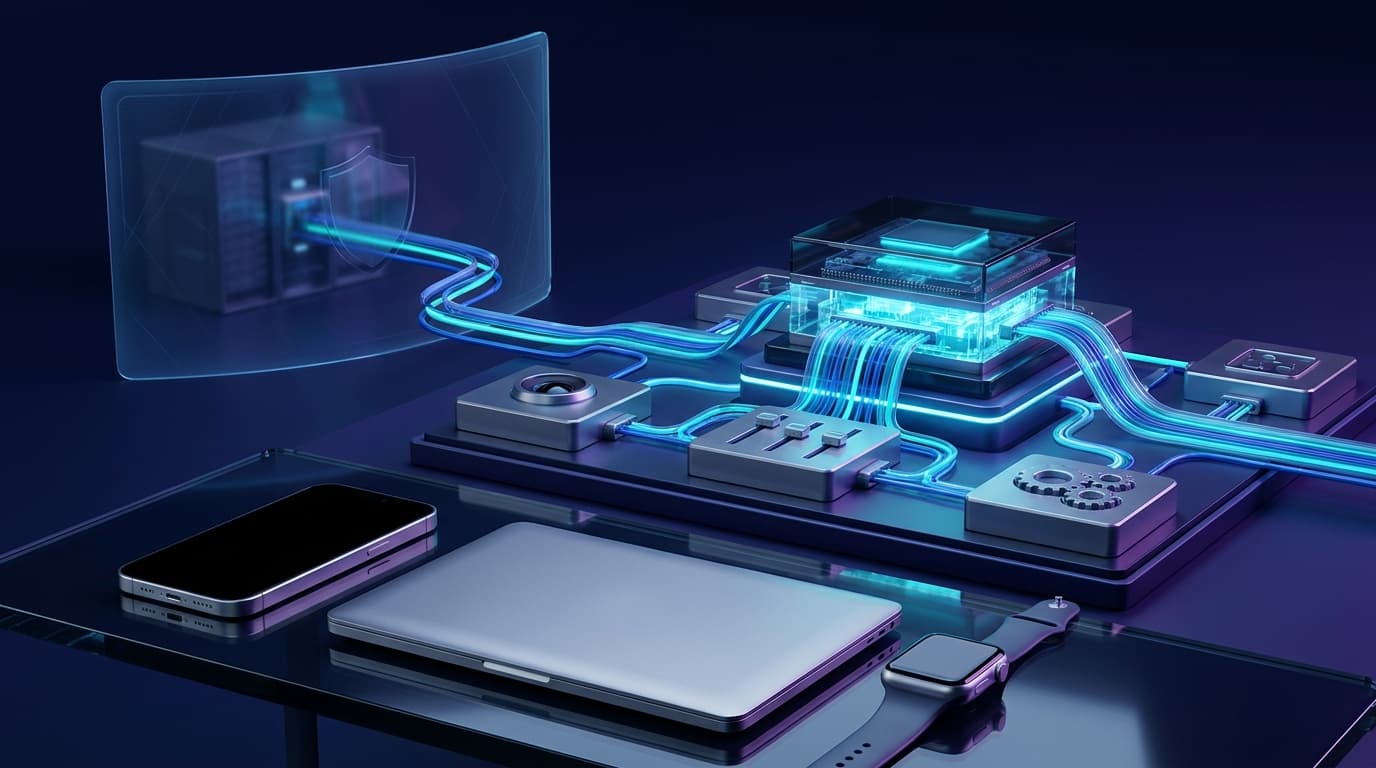
It means Apple is defining AI as workflow orchestration across:
- local model inference
- structured tool use
- screen context
- app intents
- downstream actions
That is the architecture of a usable AI operating layer.
It is also how you make AI sticky without forcing users into a separate destination app.

Why the local model strategy matters more in 2026 than it did in 2025
Last year, Apple could talk about privacy and on-device inference as differentiators.
This year, that argument has to become operational.
The Foundation Models update notes that Apple has already been iterating the model itself, including better instruction following, stronger tool calling, and a Python SDK for working with the on-device model. That matters because platform AI only becomes real when the vendor shows that the model, the APIs, and the developer workflow are all moving together. (Apple Foundation Models updates)
This is where Apple's position gets more interesting.
OpenAI, Anthropic, Google, and Microsoft are all fighting to become the cloud control plane for AI work. Apple does not need to beat them at that game everywhere.
It needs to own the local execution environment for a huge installed base of trusted devices.
If Apple can make local model access good enough for summarization, extraction, lightweight planning, structured outputs, visual lookup, and Shortcuts-driven actions, then it does not need to win the chatbot beauty contest to matter.
It just needs to become the default substrate for everyday intelligent work on Apple hardware.
That is a much stronger business than one keynote-friendly assistant personality.
Siri still matters, but mostly as distribution
None of this means Siri is irrelevant.
Siri still matters because it is the mass-market entry point and because Apple needs to repair credibility after repeated delays. Reuters captured the tension cleanly: Apple has to improve Siri, but it also has to show how developers can take advantage of AI themselves. That second requirement is the real load-bearing one. (Reuters via Investing.com)
If Siri gets better, great.
But Siri alone does not create an ecosystem moat.
A developer platform does.
The platform story is what turns one assistant refresh into thousands of app-specific workflows that summarize, classify, search, trigger actions, and adapt to user context without shipping sensitive data off-device by default.
That is a real strategic wedge.
My take
The biggest AI story around WWDC26 is not whether Apple finally lands a convincing Siri demo.
It is that Apple is making a more serious argument about where intelligence should live.
Close to the device.
Close to the workflow.
Close to the app surfaces where people already do real work.
That is the right bet for Apple, and it is more defensible than trying to out-chat the labs that already dominate frontier model mindshare.
If this strategy works, Apple does not have to win by having the flashiest assistant.
It can win by making intelligence native, local, and actionable across the software stack that developers already use.
That would be the first genuinely coherent Apple AI story in a long time.

Sources: Apple WWDC26 announcement, Apple Intelligence developer overview, Apple Foundation Models updates, Reuters on WWDC26 AI pressure via Investing.com