AI's Shift from Hype to Pragmatism in 2026
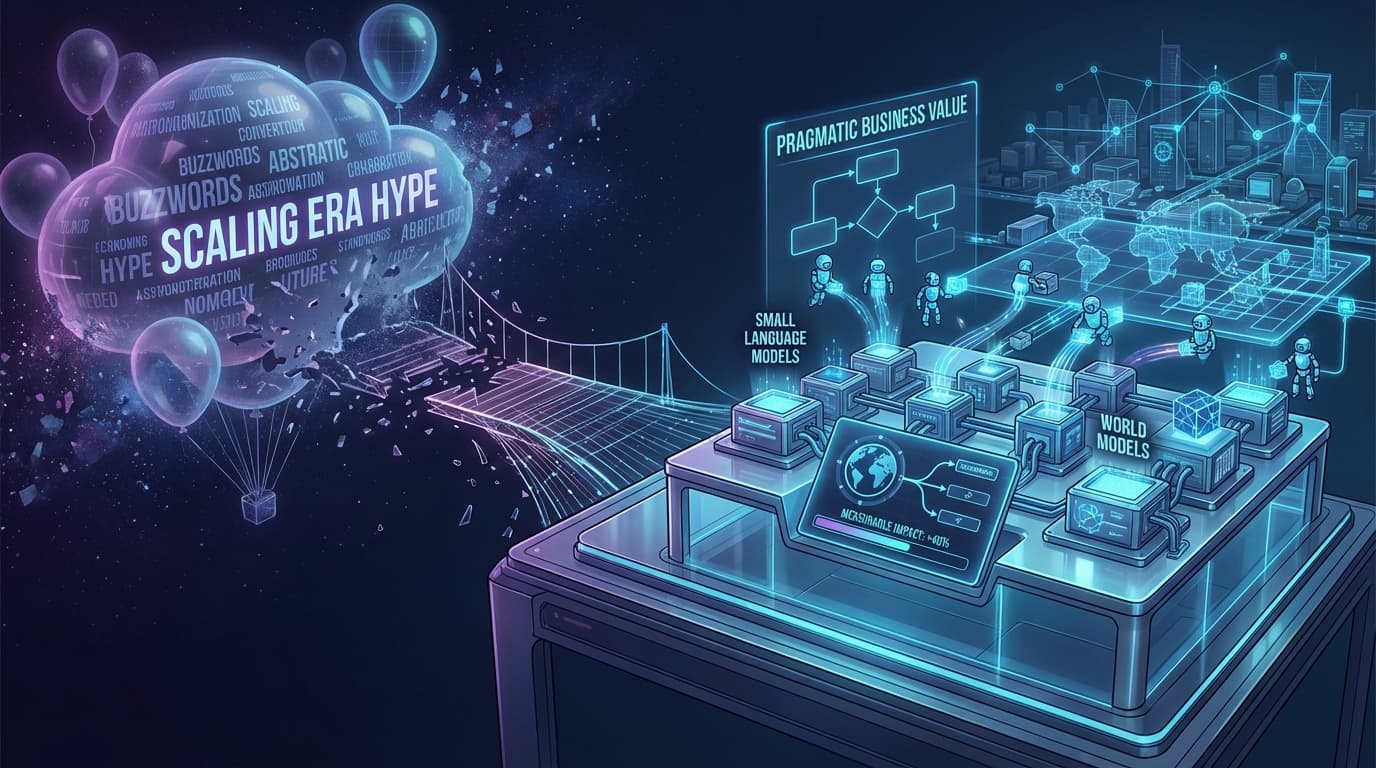
If 2025 was the year AI got a vibe check, 2026 is the year the technology gets practical. The industry is moving from chasing bigger models to delivering measurable business value through small language models, world models, and agentic workflows.
Listen to this post
If 2025 was the year AI got a vibe check, 2026 is the year the technology gets practical. I've been watching this space closely for my clients at Defendre Solutions, and the shift is unmistakable. The conversation has moved from "look what AI can do" to "here's how AI actually helps my business."
The industry is sobering up. After years of chasing bigger models and flashier demos, we're finally seeing a focus on what matters: making AI usable, affordable, and integrated into real workflows. This isn't about dampening enthusiasm. It's about directing that energy toward solutions that deliver measurable value.
The End of the Scaling Era
For the past decade, the AI industry operated on a simple assumption: bigger is better. OpenAI's GPT-3 proved that scaling up models 100x could unlock surprising new capabilities without explicit training. This kicked off what experts call the "age of scaling"—a period defined by the belief that more compute, more data, and larger transformer models would inevitably drive the next breakthroughs.
That era is ending.
As Ilya Sutskever noted in a recent interview, current models are plateauing. Pretraining results have flattened, indicating we need new ideas, not just more GPUs. Yann LeCun has long argued against overreliance on scaling, stressing the need for better architectures. Kian Katanforoosh, CEO of AI agent platform Workera, predicts we'll find a significantly better architecture than transformers within five years.
What this means for your business:
-
The performance gap between frontier and second-tier models is narrowing
-
Cost-effective alternatives are becoming viable for most use cases
-
You don't need to pay premium prices for bleeding-edge models anymore
-
Focus shifts from model size to application fit
Small Language Models: The Enterprise Workhorse
Large language models excel at generalizing knowledge, but 2026 is the year small language models (SLMs) become the staple for mature AI enterprises. Andy Markus, AT&T's chief data officer, put it well: "Fine-tuned SLMs will be the big trend and become a staple used by mature AI enterprises in 2026, as the cost and performance advantages will drive usage over out-of-the-box LLMs."
The math is compelling. When properly fine-tuned, SLMs match larger models in accuracy for enterprise business applications while being superb in cost and speed. Mistral has demonstrated this with their open-weight models, showing smaller models can outperform larger ones on specific benchmarks after fine-tuning.
Key advantages of SLMs for business:
-
Cost efficiency: Dramatically lower inference costs at scale
-
Speed: Faster response times for real-time applications
-
Privacy: Can run locally without sending data to third parties
-
Customization: Easier to fine-tune for domain-specific tasks
-
Edge deployment: Work on devices without constant cloud connectivity
I've seen this firsthand with clients who've moved from GPT-4 to fine-tuned smaller models for specific tasks like document classification and customer support triage. The savings are substantial, and the performance is often better for narrow use cases.
World Models and Reasoning: From Promise to Practice
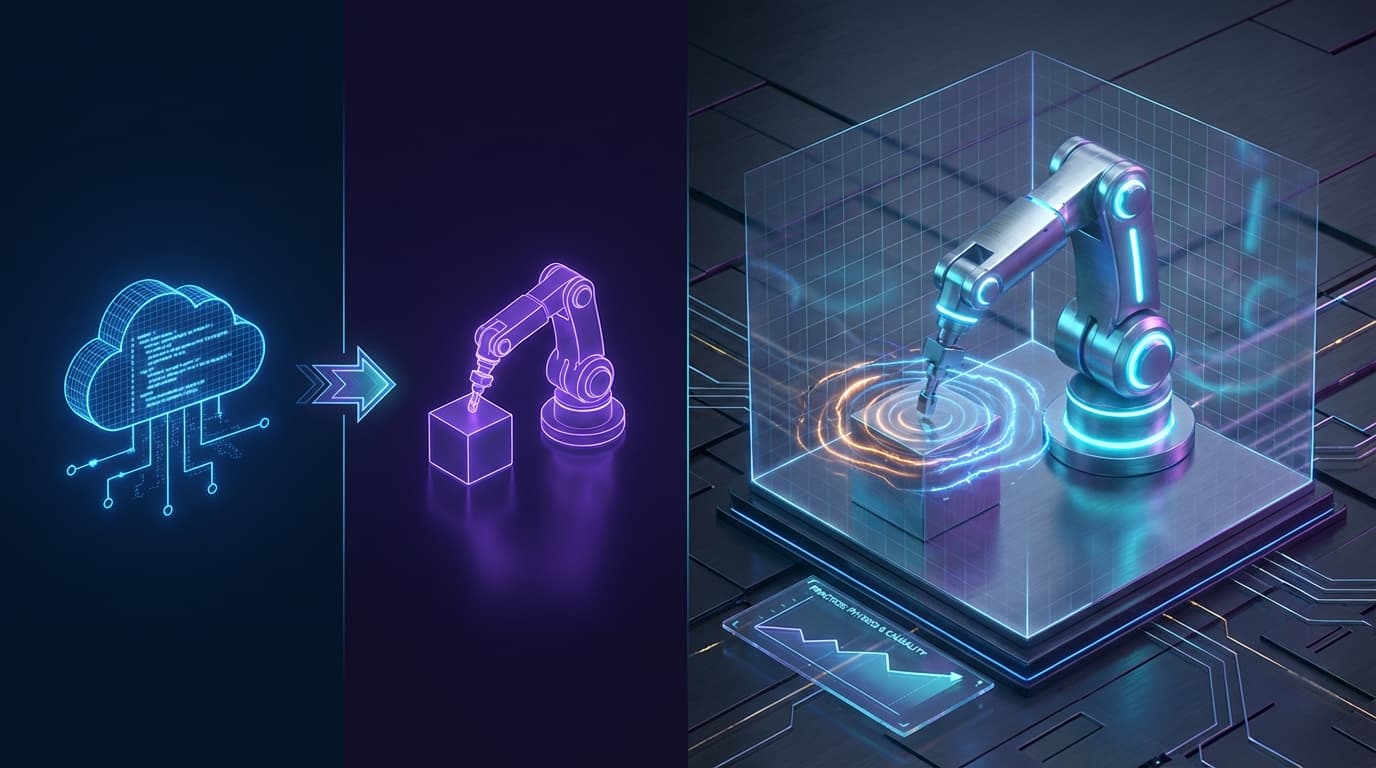
Humans don't learn just through language; we learn by experiencing how the world works. LLMs don't actually understand the world; they predict the next word. That's why researchers believe the next leap will come from world models—AI systems that learn how things move and interact in 3D spaces so they can make predictions and take actions.
2026 is shaping up to be a breakout year for this technology. Consider the activity:
- Yann LeCun left Meta to start his own world model lab, reportedly seeking a $5 billion valuation
-
Fei-Fei Li's World Labs launched Marble, its first commercial world model
-
Google's DeepMind continues advancing its Genie world model
-
Runway released its first world model, GWM-1
-
General Intuition raised $134 million to teach agents spatial reasoning
The near-term impact for businesses will likely appear first in video games and simulation, but the implications extend further. Virtual environments are becoming critical testing grounds for the next generation of foundation models. For industries like logistics, manufacturing, and robotics, world models promise more capable planning and prediction systems.
Business implications:
-
Better simulation for training and testing AI systems
-
More robust planning capabilities for logistics and operations
-
Enhanced virtual training environments for employees
-
Improved predictive maintenance through better physical world understanding
AI Agents: From Demos to Daily Workflows
Agents failed to live up to the hype in 2025, largely because connecting them to actual work systems was difficult. Without access to tools and context, most agents were trapped in pilot workflows.
That's changing rapidly. Anthropic's Model Context Protocol (MCP), described as "USB-C for AI," has become the missing connective tissue. It lets AI agents talk to external tools like databases, search engines, and APIs. OpenAI and Microsoft have embraced MCP, and Anthropic donated it to the Linux Foundation's new Agentic AI Foundation to help standardize open source agentic tools. Google is standing up managed MCP servers to connect agents to its products.
With this friction reduced, 2026 is likely to be the year agentic workflows move from demos into day-to-day practice. As Rajeev Dham of Sapphire Ventures notes, we'll see agent-first solutions taking on "system-of-record roles" across industries.
What this looks like in practice:
-
Voice agents handling end-to-end intake and customer communication
-
Sales agents that research prospects, draft personalized outreach, and schedule meetings
-
IT support agents that diagnose issues and implement fixes
-
HR agents that handle onboarding paperwork and answer employee questions
The Real Impact: Augmentation, Not Automation
The fear that AI would eliminate jobs has given way to a more nuanced reality. The technology isn't autonomous enough to replace humans wholesale, and frankly, that's not what most businesses want right now. What they want is help.
2026 will be the year we realize AI works best as an augmentation tool. As Katanforoosh notes, "2026 will be the year of the humans." Companies are discovering that AI is most valuable when it handles repetitive tasks while humans focus on judgment, creativity, and relationships.
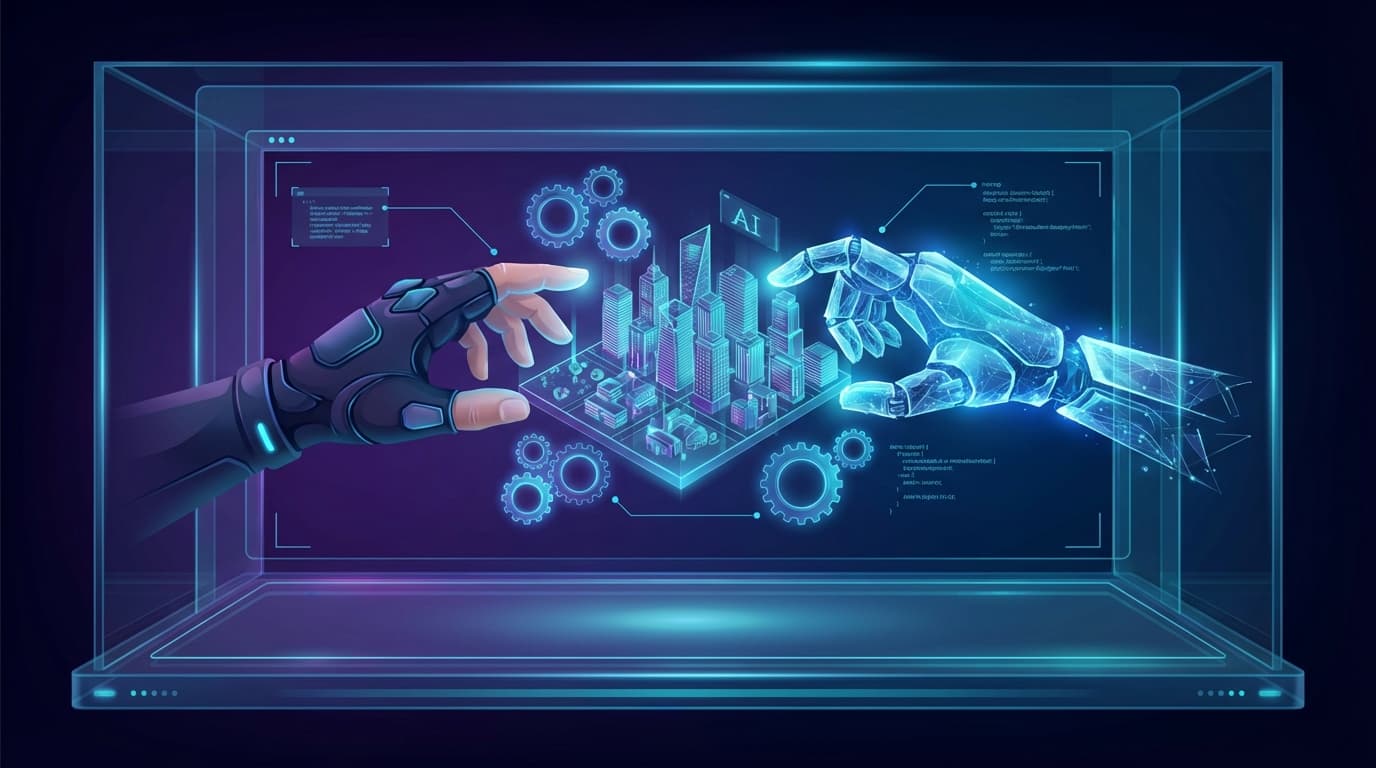
I'm already seeing this shift with clients. Instead of cutting headcount, they're redeploying people to higher-value work. New roles are emerging in AI governance, transparency, safety, and data management. The goal isn't to remove the human element; it's to amplify it.
Actionable Takeaways for Business Leaders
If you're planning your AI strategy for 2026, here's my advice based on what I'm seeing work in the field:
-
Audit your AI spending. Are you paying for frontier models where smaller, fine-tuned alternatives would work? The savings can be substantial.
-
Identify narrow use cases. SLMs excel at specific tasks. Find three to five well-defined workflows where a fine-tuned small model could replace a general-purpose LLM.
-
Experiment with agents now. Set up MCP connections to your key systems. The organizations that figure out agent integration early will have a significant advantage.
-
Focus on augmentation first. Look for ways AI can make your existing team more productive rather than replacing them entirely.
-
Invest in data quality. Fine-tuning requires good data. Clean, labeled datasets will be a competitive advantage.
-
Plan for multi-agent systems. Gartner predicts 70% of multi-agent systems will contain agents with narrow, focused roles by 2027. Design your architecture accordingly.
Looking Ahead
The shift from hype to pragmatism doesn't mean AI is becoming boring. It means it's becoming useful. The companies that thrive in 2026 will be those that stop asking "what can AI do?" and start asking "what do we need done?"
The tools are maturing. The costs are coming down. The integration pathways are standardizing. This is the year AI stops being a science experiment and becomes business infrastructure.
I'm optimistic about what this means for businesses of all sizes. When technology becomes practical, accessible, and focused on real problems, everyone benefits.
Steve is the founder of Defendre Solutions, helping businesses strengthen their operations through strategic consulting and smart technology implementation. He writes about practical AI adoption for business leaders who want results, not buzzwords.