The Real AI News on March 2, 2026 Isn’t the $110B. It’s the Runtime.
OpenAI's February 27 funding blast is still the biggest AI story on Monday, March 2, 2026. But the number everyone keeps repeating is not the part I care about most. The Amazon deal, and the stateful runtime behind it, is the part that could actually change how AI gets used at work.
Listen to this post
As of Monday, March 2, 2026, I think the biggest AI story is still the one that landed on February 27.
Yes, the headline number is absurd. OpenAI announced $110 billion in new funding at a $730 billion pre-money valuation, with $50 billion from Amazon, $30 billion from NVIDIA, and $30 billion from SoftBank. That kind of number eats the news cycle by itself.
But if you stop at the funding total, you miss the more interesting part.
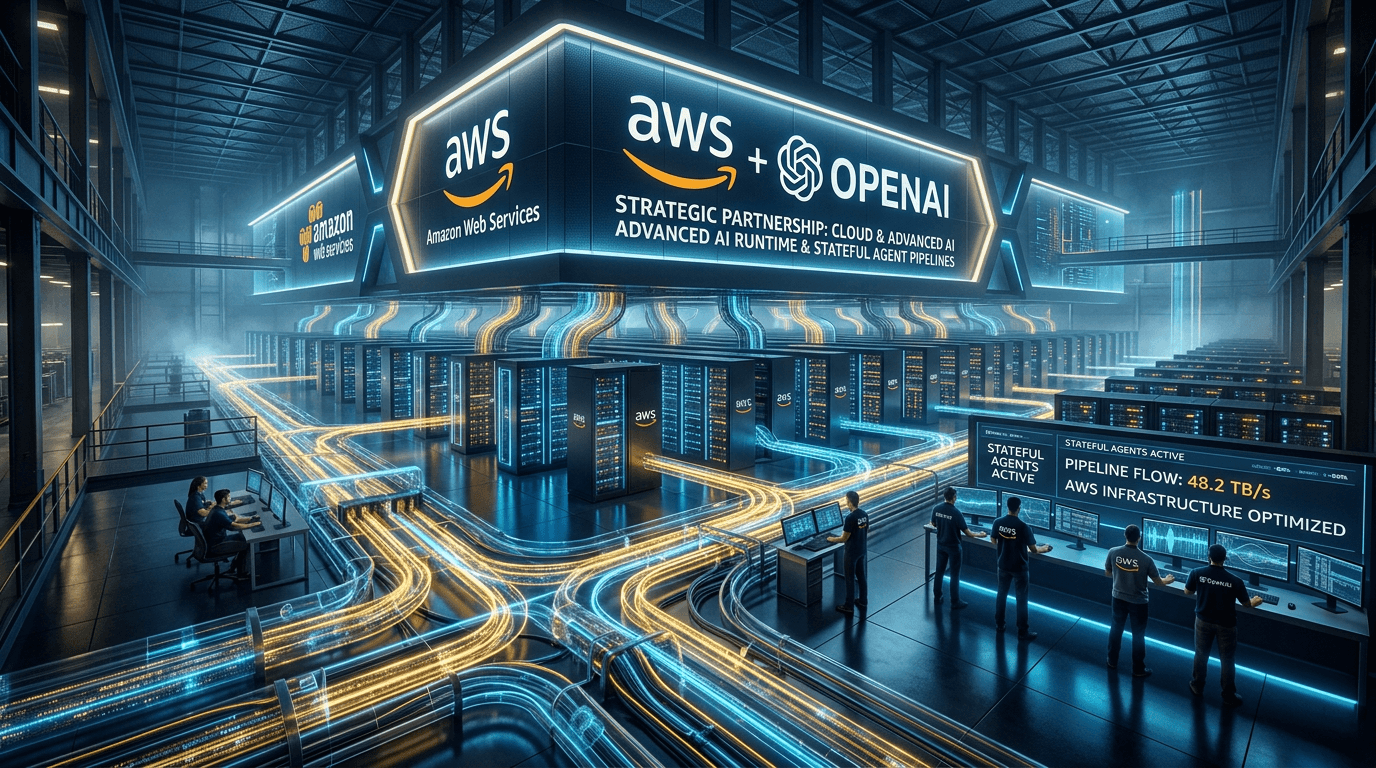
The real story is that OpenAI and Amazon are building what they call a Stateful Runtime Environment for Amazon Bedrock. And for anyone who actually builds or buys AI systems, that matters more than one more giant valuation headline.
Why I think this is the part people should pay attention to
Most AI products still feel stateless. You ask a question, the model answers, and then you start over. Even when the system looks polished, a lot of it is still just prompt in, response out, with a bunch of glue code trying to fake continuity.
That works for quick tasks. It is clumsy for actual work.
Amazon says this new runtime is meant to let agents keep context, remember prior work, use tools, access data sources, and tap compute without getting rebuilt from scratch every time. If that ships the way it is being described, that is a real shift. It means the model stops acting like a clever autocomplete layer and starts acting more like a long-running worker.
That is a much bigger deal than another benchmark chart.

The money is huge. The distribution is the bigger tell.
The $110 billion funding round obviously matters. You do not raise that kind of capital unless the market believes the demand is there, or at least believes it will be there soon.
Still, what caught my eye was the distribution setup.
AWS is now the exclusive third-party cloud distribution provider for OpenAI Frontier. That means OpenAI is not only raising money. It is placing itself closer to the place where enterprises already run real systems, with budgets, controls, procurement, and security reviews baked in.
That is how a technology goes from “interesting” to “someone’s boss approved it.”
OpenAI also said it will consume about 2 gigawatts of Trainium capacity through AWS infrastructure. That is not a cute partnership detail. That is a loud signal that OpenAI is willing to bet on purpose-built infrastructure, not just keep chasing general GPU supply forever.
I keep seeing people frame this as a funding story. It is partly that. I think it is more accurate to call it a systems story.
This is not an OpenAI-Microsoft breakup
There is another reason this story matters. It says a lot about where the infrastructure stack is going.
Microsoft and OpenAI put out a joint statement the same day to make one thing very clear: the core partnership is still in place. Microsoft says Azure remains the exclusive cloud provider for stateless OpenAI APIs, and OpenAI's first-party products, including Frontier, will continue to be hosted on Azure.
So no, this is not some dramatic divorce.
It is something more practical: OpenAI is adding lanes.
Azure keeps the stateless API side. AWS becomes a major route for distribution and a home for this new stateful agent runtime. NVIDIA stays tied in on inference and training capacity. That is not messy. It is exactly what a company does when demand is getting too big for a single pipe.

Why this changes the conversation for enterprise AI
I spend a lot of time thinking about where AI stops being impressive in demos and starts being useful in the parts of a business people actually depend on.
This is where that starts to happen.
The missing piece for a lot of enterprise AI has not been raw model capability. It has been reliability, memory, permissions, tool access, and the ugly operational stuff that nobody puts in keynote videos. A stateful runtime is aimed straight at that problem.
If you can give agents durable context, access to the right systems, and a place to run that fits inside existing AWS infrastructure, you remove a lot of the friction that has kept “AI agents” trapped in pilot mode.
That does not mean every company suddenly gets magical autonomous workers next quarter. I am not buying that story. What I do think happens is simpler: more teams start using agents for narrow, repeatable work because the plumbing gets less painful.
That is how the real adoption curve happens. Not in one giant leap. In a bunch of boring decisions that make deployment easier.
My read, plain and simple
On March 2, 2026, the biggest AI news is still OpenAI's February 27 announcement. But the part worth remembering is not the valuation flex.
It is that the biggest labs are moving past the old chat interface model and fighting over where agents live, what they remember, and which cloud stack owns the workflow.
That fight is more important than the headline number, because it will decide who actually gets used inside real companies.
If you build on AI, watch the runtime.
That is where this gets real.
Steve Defendre is the founder of Defendre Solutions. He writes about AI, software, and where useful systems beat flashy demos.