Anthropic Just Launched an AI Security Scanner — and Cybersecurity Stocks Are Paying the Price
Anthropic's new AI-powered security scanning tool is shaking up the $200B cybersecurity industry. CrowdStrike, Palo Alto, and SentinelOne took hits as the market asks: does AI commoditize what these firms charge billions to do?
Listen to this post
The cybersecurity industry has spent two decades building a moat around specialized expertise, proprietary threat intelligence, and expensive enterprise tooling. Today, that moat got a lot shallower.
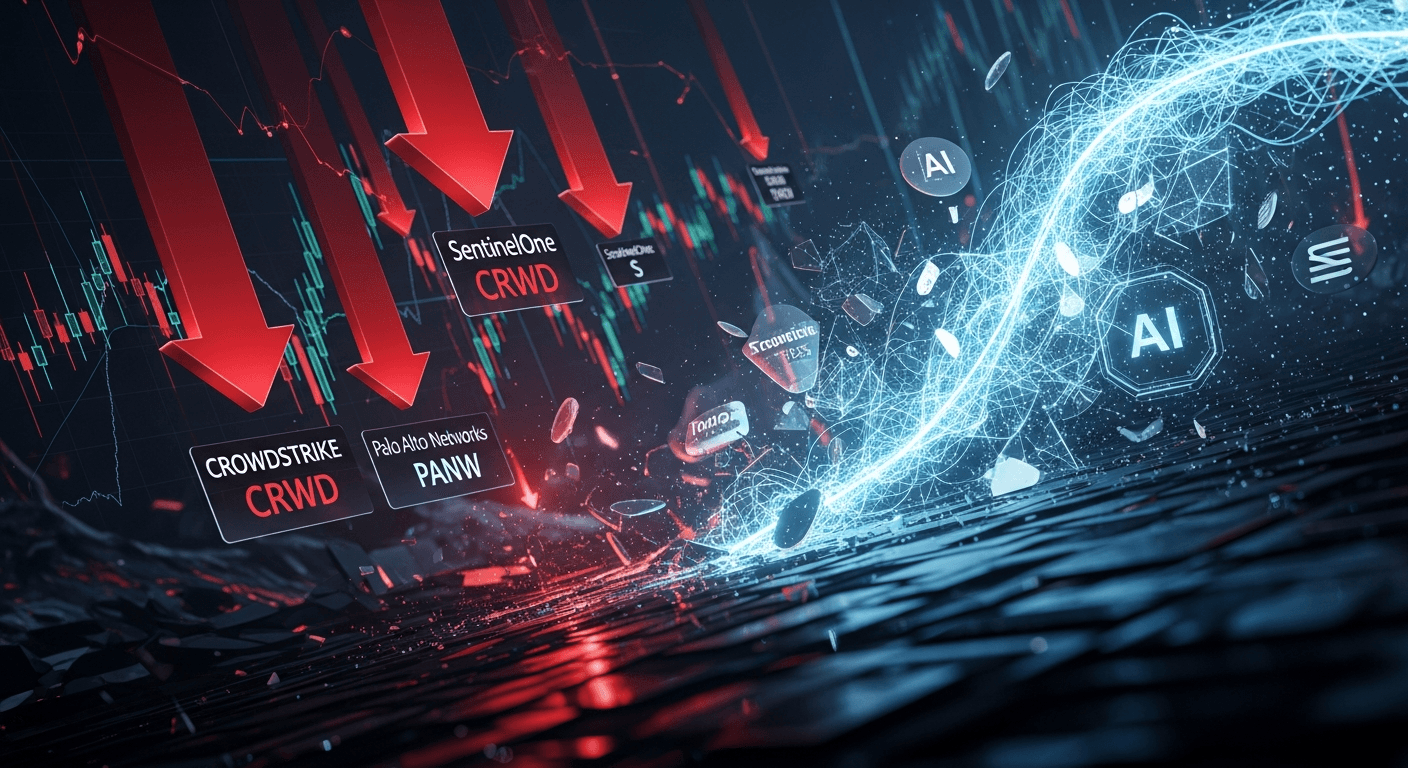
Anthropic announced an AI-powered security scanning tool built on Claude that can autonomously analyze codebases, infrastructure configurations, API endpoints, and cloud environments for vulnerabilities — in real time, at a fraction of the cost of traditional managed security services. The market reaction was immediate: CrowdStrike, Palo Alto Networks, and SentinelOne each dropped between 4% and 8% on the news, as investors started doing the math on what AI-native security means for sector valuations.
What Anthropic Actually Built
At its core, this is Claude doing what it already does well — analyzing code and text — but applied systematically to security surface area. The tool reportedly:
- Scans source code for common vulnerability classes (OWASP Top 10, injection flaws, insecure deserialization, broken access control) with accuracy that reportedly matches or exceeds commercial SAST tools
- Reviews infrastructure-as-code (Terraform, Kubernetes configs, Dockerfiles) for misconfigurations that lead to exposed buckets, overprivileged IAM roles, or unauthenticated services
- Analyzes API traffic patterns using behavioral heuristics to flag anomalous access patterns without requiring signature-based rule sets
- Generates prioritized remediation plans in plain English, cutting the time between detection and developer action
The key differentiator isn't just capability — it's accessibility. Traditional security tooling requires certified professionals, multi-week implementations, and six-figure annual contracts. Anthropic's scanner is API-native, developer-friendly, and integrates directly into CI/CD pipelines.
Why the Market Reacted
To understand the stock reaction, you need to understand what CrowdStrike, Palo Alto, and SentinelOne actually sell. It is not just software. It is expertise, brand trust, compliance certifications, threat intelligence networks, and sales relationships with CISOs who have been burned by bad vendors before.
But a significant portion of their revenue comes from things that can be automated: vulnerability scanning, compliance reporting, configuration auditing, and alert triage. These are not secret capabilities that require a team of ex-NSA engineers. They are systematic processes that a sufficiently capable AI model can replicate at scale.
The Palo Alto Problem
Palo Alto Networks has been on a multi-year "platformization" push, trying to consolidate security tooling onto a single vendor. Their thesis: customers pay a premium for integrated platforms rather than best-of-breed point solutions. Anthropic's scanner threatens to insert itself as an AI-native horizontal layer that undercuts the integration argument entirely — not by building a better platform, but by making the underlying tasks cheap enough that the platform premium disappears.
The CrowdStrike Complication
CrowdStrike's Falcon platform is endpoint-focused, which is somewhat insulated from what Anthropic announced today. But their Exposure Management and Cloud Security segments are directly in the blast radius. If AI can do continuous attack surface monitoring and cloud config scanning for pennies per query, the $40,000/year Falcon Horizon subscription is going to be a harder sell in next year's budget cycle.
The SentinelOne Squeeze
SentinelOne has been the most aggressive about integrating AI into their platform, with their Purple AI product that lets security analysts ask natural language questions about their environment. But "AI features bolted onto a traditional EDR platform" is a very different value proposition than "AI-native security tool built from the ground up by the company that created Claude." The positioning gap just widened.
The Bigger Picture: AI Is Eating Software Security
This is not an isolated event. It is the next wave of a pattern we have been watching accelerate: AI systematically replacing the process layer of professional services industries.
Legal document review. Radiology pre-reads. Financial analysis. Code generation. In each case, AI did not eliminate the profession — it eliminated the billable hours attached to the routine work, forcing practitioners up the value stack toward judgment, strategy, and accountability.
Security is next. The question is not whether AI will change how vulnerability management, compliance auditing, and threat detection get done. The question is who captures the value when the cost curves collapse.
Anthropic is making an interesting bet: that the model provider — not the security services layer built on top of it — should own the security workflow directly. That is a departure from the typical "we're a platform, not a product" positioning. It also puts them on a collision course with a $200 billion industry that has spent years telling enterprise customers that security is too important to trust to a generalist AI.
What This Means If You're Building
If you are building a startup in the security space right now, you are facing one of two realities:
-
You are building something that Anthropic (or OpenAI, or Google) will release for free in 18 months. This is the commodity trap. If your value proposition is "we scan code for vulnerabilities," you are probably in trouble.
-
You are building at the layer above the AI — context, compliance, accountability, and integration. Who is responsible when the AI scanner misses a critical CVE? Who maintains the threat intelligence graph? Who holds the vendor relationships and certifications that procurement requires? That layer is still valuable, probably more valuable than before, because the AI handles the grunt work and the human handles the judgment.
At Defendre Solutions, I have been thinking about this framing a lot as we advise clients on AI adoption strategies. The firms that survive this wave are the ones that stop defending their old processes and start asking what genuinely human judgment enables that the AI cannot replace.
The Market Is Right to React — But Probably Overreacting
Stock markets price expectation, not reality. The reality is that Anthropic's scanner is a real product that will win real customers and compress real margins for legacy vendors. But it is not going to eliminate CrowdStrike by end of Q2.
Enterprise security buying cycles are long. Compliance requirements demand validated, audited tools. CISOs have careers on the line when they switch security vendors. The incumbents have 18 to 36 months to respond before the revenue impact is material.
That is enough time to build, but not enough time to ignore. The firms that treat today's news as an isolated product announcement from an AI lab will not survive the decade. The ones that treat it as a signal that the entire paradigm is shifting — from human-expert-delivered security to AI-assisted security with human oversight — will be positioned to lead it.
Today is a warning shot. The incumbents should be listening.
Steve Defendre is the founder of Defendre Solutions, an AI consulting firm helping organizations adopt AI tools strategically. He writes about AI, veterans in tech, and the future of work.