China's Five-Year Plan to Dominate AI by 2030
China's 15th Five-Year Plan is 141 pages of ambition: humanoid robots, brain-computer interfaces, flying cars, quantum tech, 6G. The term 'artificial intelligence' appears 50+ times. With 2 million robots already in Chinese factories and 150+ humanoid robot companies, this isn't a wish list. It's a procurement order.
Listen to this post
I read all 141 pages of China's 15th Five-Year Plan so you don't have to. The term "artificial intelligence" appears more than 50 times. That's not normal for a government planning document. That's obsession.
The plan, finalized this week during China's annual legislative sessions, lays out the clearest national AI strategy any country has ever published. The goal: integrate AI into 90% of China's economy by 2030 and build an AI-related industry worth 10 trillion yuan, roughly $1.45 trillion. For context, that's larger than the entire GDP of most countries.
But the numbers aren't what caught my attention. What caught my attention is how specific the plan is about what gets built next.
Ten priority bets
China named 10 investment priority areas. Read them carefully because they tell you where hundreds of billions of dollars are about to flow:
- Humanoid robots
- AI workplace systems
- Brain-computer interfaces
- Flying cars and low-altitude equipment
- Quantum technology
- 6G networks
- Nuclear fusion
- Biomanufacturing
- Hyperscale computing clusters
- Agentic AI (systems that handle tasks beyond conversation)
This isn't a typical government wish list. The plan includes a 10% increase in the annual science and technology budget, plus a 7% annual R&D investment growth target. They're not just naming priorities. They're funding them.
One term stood out to me: "embodied intelligence" (具身智能). It barely existed in Chinese policy documents before 2023. Now it has a dedicated inset box among the top 10 new industry tracks. That's how fast Beijing moves when it decides something matters.

The robot army is already here
Here's what makes this plan different from Western AI strategies: China isn't starting from scratch. They're scaling what already works.
In 2024, Chinese factories deployed 2 million robots. That's five times more than the United States. In 2025, roughly 16,000 humanoid robots were sold worldwide. About 90% of them came from China. There are now more than 150 humanoid robot companies operating in the country.
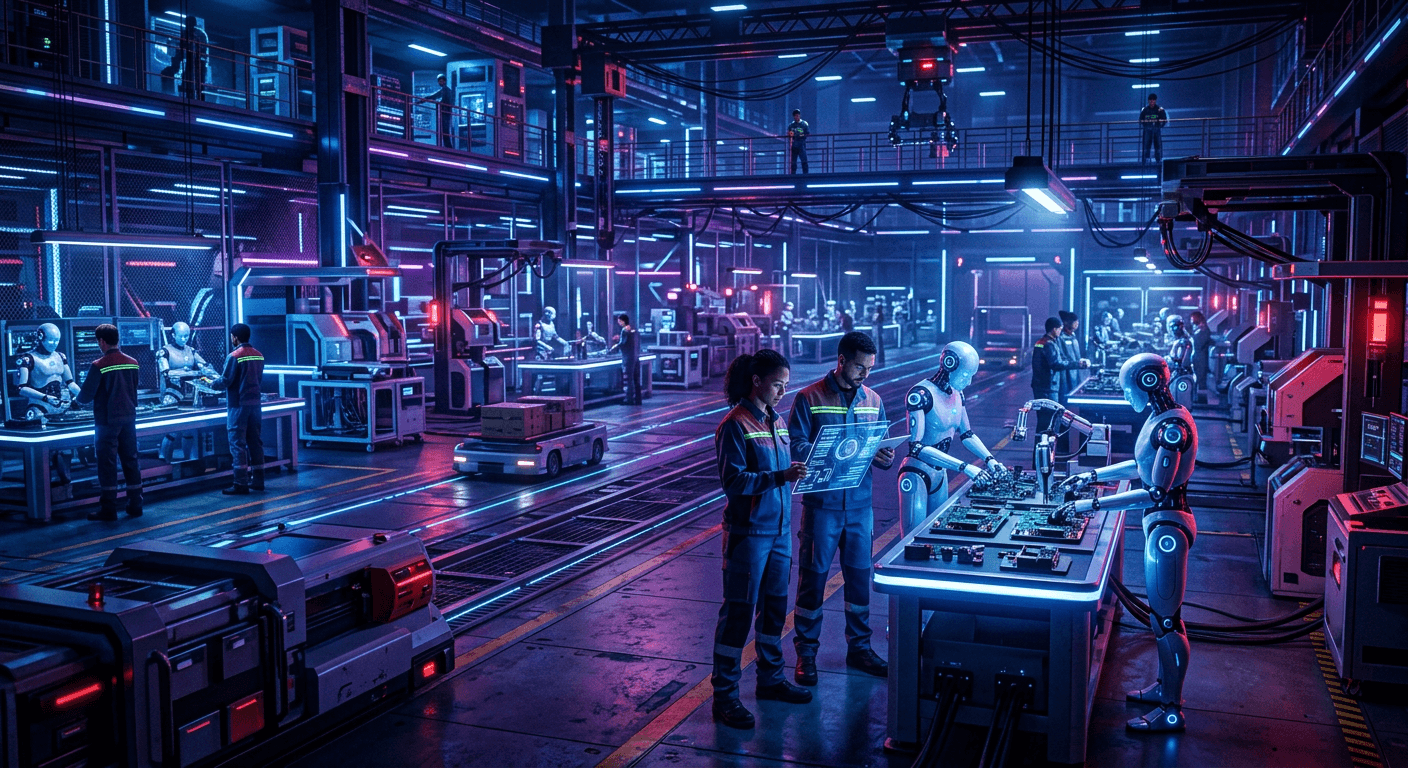
Some Chinese factories have gone fully autonomous. They call them "dark factories" because they operate with minimal lighting. No humans on the floor means no need for lights. Rows of robotic arms assembling products in near-darkness. It sounds like science fiction, but it's happening right now in Guangdong and Zhejiang.
The plan also calls for 40+ state-funded robot training centers that generate millions of data points from real-world operations. Robotics isn't treated as a standalone sector in this plan. It's woven across manufacturing, digital transformation, elderly care, national security, and cultural development. That approach makes sense when you remember China has an aging population and a slowing economy. Robots aren't just cool technology for Beijing. They're an economic survival strategy.
Dan Wang from Eurasia Group put it well: "For the first time, China wants to lead in a number of technologies. Previously, the focus was always catching up with the West."
The open-source play
Here's something that doesn't get enough attention. Most Chinese AI models are freely downloadable and customizable. While US companies charge subscription fees and lock down their models behind APIs, China is flooding the world with open-source alternatives.
Kyle Chan, a Brookings Institution fellow, has been tracking this. The strategy is deliberate. China wants its AI models everywhere, adopted by developers globally, embedded in systems across Southeast Asia, Africa, Latin America. You don't dominate AI just by being the best. You dominate by being the most available.
It's the same playbook Huawei used with telecom infrastructure. Offer it cheap or free, get it adopted widely, then become the default. The US learned this lesson too late with 5G. China is applying it to AI before the competition even notices.

The chip gap problem
But China has a real weakness, and the plan can't paper over it.
The best Chinese AI chip, made by Huawei, is still five times less powerful than the best US AI chips. That gap matters. Training frontier AI models requires the most powerful hardware available. The US has maintained export bans on its most advanced chips to China since 2022, tightening and loosening them irregularly since then.
Chris McGuire, a senior fellow at the Council on Foreign Relations, is blunt about it: "China's strategy of producing larger quantities of inferior chips is not working."
China's response has been to pour money into domestic chip development. The Five-Year Plan explicitly calls for forging domestic AI chip capabilities and building hyperscale computing clusters. But quality is a different challenge than quantity. You can't compensate for a 5x performance gap just by building more fabs. Not yet, anyway.
This is the one area where the US still has clear leverage. And Beijing knows it. That's partly why Xi Jinping is expected to host President Trump in Beijing later this month to discuss a trade truce. Chips are the bottleneck.
What this means for everyone else
I think a lot of people in the West still view China's AI ambitions through a 2020 lens, when Chinese AI was mostly about surveillance cameras and facial recognition. That era is over.
This Five-Year Plan is about something much bigger. It's about building an economy where AI handles everything from manufacturing to elder care to national defense. Where humanoid robots outnumber factory workers. Where open-source AI models trained on Chinese data become the global default for developing nations.
Rebecca Arcesati from the Mercator Institute framed it correctly: "Which countries successfully implement AI in the coming years will determine who leads the AI revolution."
China also did something interesting on the labor side. In 2024, a Chinese court ruled that firing workers solely to replace them with AI was illegal. That's a more nuanced position than most Western countries have taken. Beijing wants AI everywhere, but it also needs social stability. You can't have 1.4 billion people and mass unemployment at the same time.
The real question isn't whether China's plan will succeed completely. It won't. No five-year plan ever does. The question is whether it succeeds enough. If China hits even 60% of these targets, if it deploys AI across just half its economy, if its humanoid robot companies capture even a fraction of the global market, the implications reshape everything.
The US is still winning on chips. China is winning on deployment, on manufacturing scale, on open-source distribution, on sheer speed of implementation. Both sides know this is the competition that defines the next decade. China just published its playbook. 141 pages. Worth reading.
Sources: ABC News, The Diplomat, Reuters, CNN Business