China just told us exactly what it's building. We should listen.
Beijing coined a new term — 'intelligent economy' — and put a $1.4 trillion price tag on its AI industry by 2030. The 15th Five-Year Plan isn't vague aspiration. It's a national blueprint with specific targets, including 90% AI agent penetration. Here's why that matters for everyone else.

Listen to this post
Most countries talk about AI strategy in press conferences and white papers that nobody reads. China does it differently. They write it into law, assign it a number, and spend the next five years executing.
On March 12, 2026, China wrapped up its annual "Two Sessions" legislative meetings and finalized the 15th Five-Year Plan. If you only read one government planning document this year, it should be this one. Not because Five-Year Plans are always exciting reading, but because this one tells you where approximately $1.4 trillion is headed.
Premier Li Qiang introduced a term nobody had used before in a Chinese government work report: "intelligent economy." He projected China's AI industry would reach 10 trillion yuan (roughly $1.4 trillion) by 2030. Zheng Shanjie, head of the National Development and Reform Commission, confirmed that figure would represent about seven percent of China's total GDP.
"The previous model of quantitative growth no longer works," Li said. That sentence alone is worth paying attention to.
What "intelligent economy" actually means
It's easy to write this off as another buzzword. Every government loves coining terms. But Chen Changsheng, deputy director of the State Council Research Office, was pretty specific about what this one means. He called it "a brand-new concept" aimed at "expanding the breadth and depth of AI empowerment of all industries, opening up new space for economic growth, cultivating new models, and strengthening new driving forces."
Strip away the bureaucratic phrasing and the intent is clear: AI isn't a sector anymore in China's planning. It's the layer that runs through everything else.
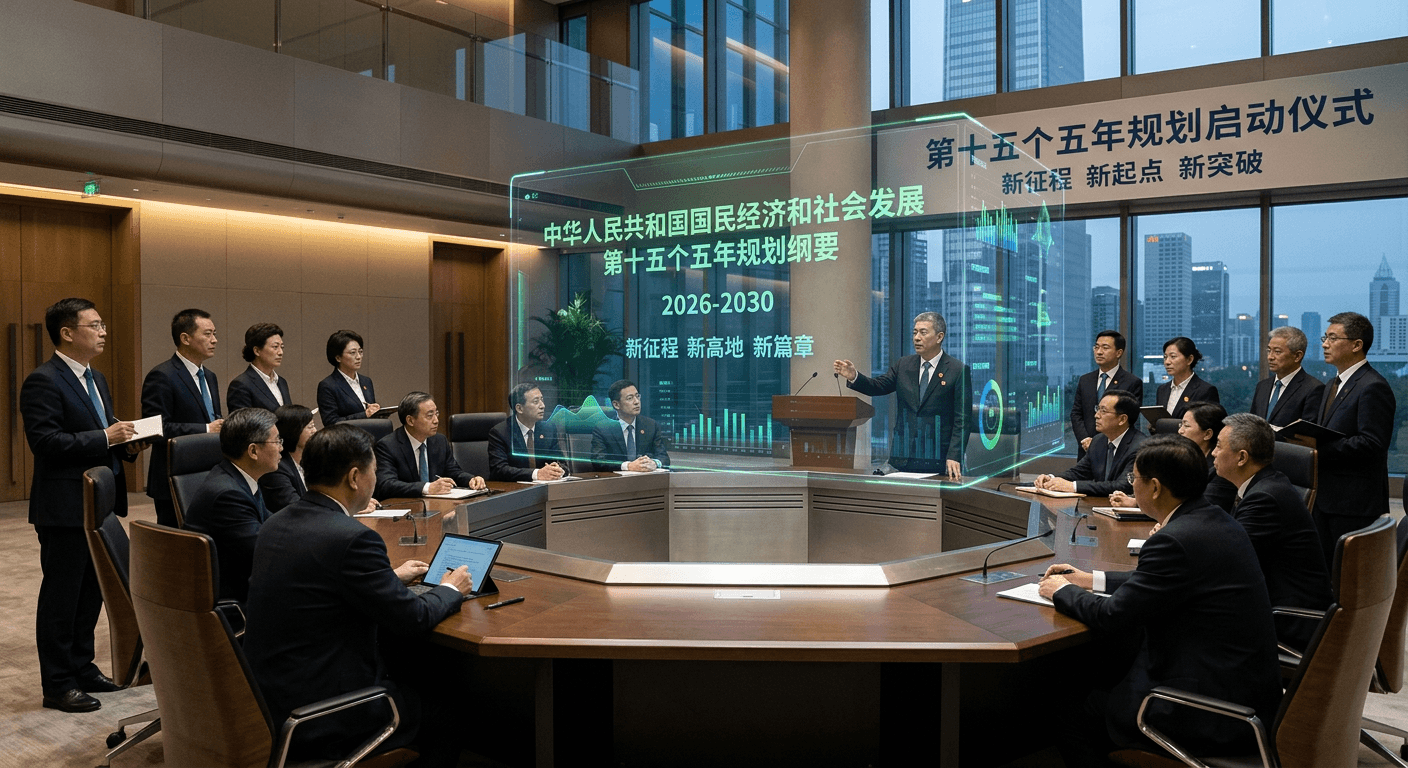
The plan builds on China's existing AI-Plus initiative, but goes further. For the first time, the government work report named AI agents specifically. It referenced open-source AI development three times. And it set a target of 90% penetration for AI agent applications by 2030.
That last number is wild. Ninety percent. Think about what that means for a country of 1.4 billion people. Even if the actual execution lands at 60%, that's still an AI deployment at a scale nobody else is attempting.
The plan also identifies robotics, new energy, aviation, and aerospace as strategic industries. But AI is the thread connecting all of them. Beijing isn't treating these as separate bets. It's treating AI as the infrastructure that makes the other bets work.
The slower growth is the strategy
Here's the part most Western analysis is going to miss. China cut its GDP growth target to 4.5-5%, down from "around 5%." A lot of headlines will frame that as weakness. It's not. It's the point.
Guo Shan, a research economist at Hutong Research, put it well: "The most notable shift this year is arguably renewed emphasis on reform." China is explicitly trading speed for something else. Seven of the 20 quantitative targets in the plan focus on livelihood: employment, income, education, healthcare. For the first time, there are specific targets for childcare and elderly care services.
Household consumption accounts for only 40% of China's GDP, compared to around 60% in developed economies. That gap is both a problem and an opportunity. If China can use AI to boost domestic consumption and services rather than just exports and manufacturing, the economic model changes in ways that are hard to compete with. A country that builds AI infrastructure primarily to improve its citizens' quality of life has different incentives than one building it primarily for enterprise SaaS margins.
I'm not saying that's definitely what will happen. Government plans and ground-level reality diverge all the time, everywhere. But the stated intent matters because it shapes where the money goes.
What this means if you're in the US
This is the part that keeps me up at night.
The American approach to AI has been almost entirely private-sector-driven. That's produced incredible results. OpenAI, Anthropic, Google, Meta — the leading foundation model labs are all American. US companies are spending hundreds of billions on AI infrastructure. The talent concentration is real.
But there's no American equivalent of a Five-Year Plan. There's no $1.4 trillion target. There's no stated goal for AI agent penetration rates across the economy. There's barely a coherent federal AI policy at all, and what exists changes with every election cycle.
China's approach has real weaknesses. Central planning gets things wrong. Bureaucratic targets create perverse incentives. The innovation that comes from messy, competitive, venture-funded chaos is real and shouldn't be discounted.
But China has one thing the US doesn't: a 2030 plan that everyone in the system is now working toward. When your competitor has a roadmap and a budget and institutional alignment, "the market will figure it out" starts to feel less reassuring.
The 90% AI agent penetration target is the one I keep thinking about. The US doesn't have a number like that. We don't even have a framework for measuring something like that. China might not hit 90%, but the act of targeting it means government procurement, regulatory frameworks, education systems, and state-owned enterprises will all orient around making it happen. That's a coordination advantage that market forces alone don't produce.
The real competition isn't models
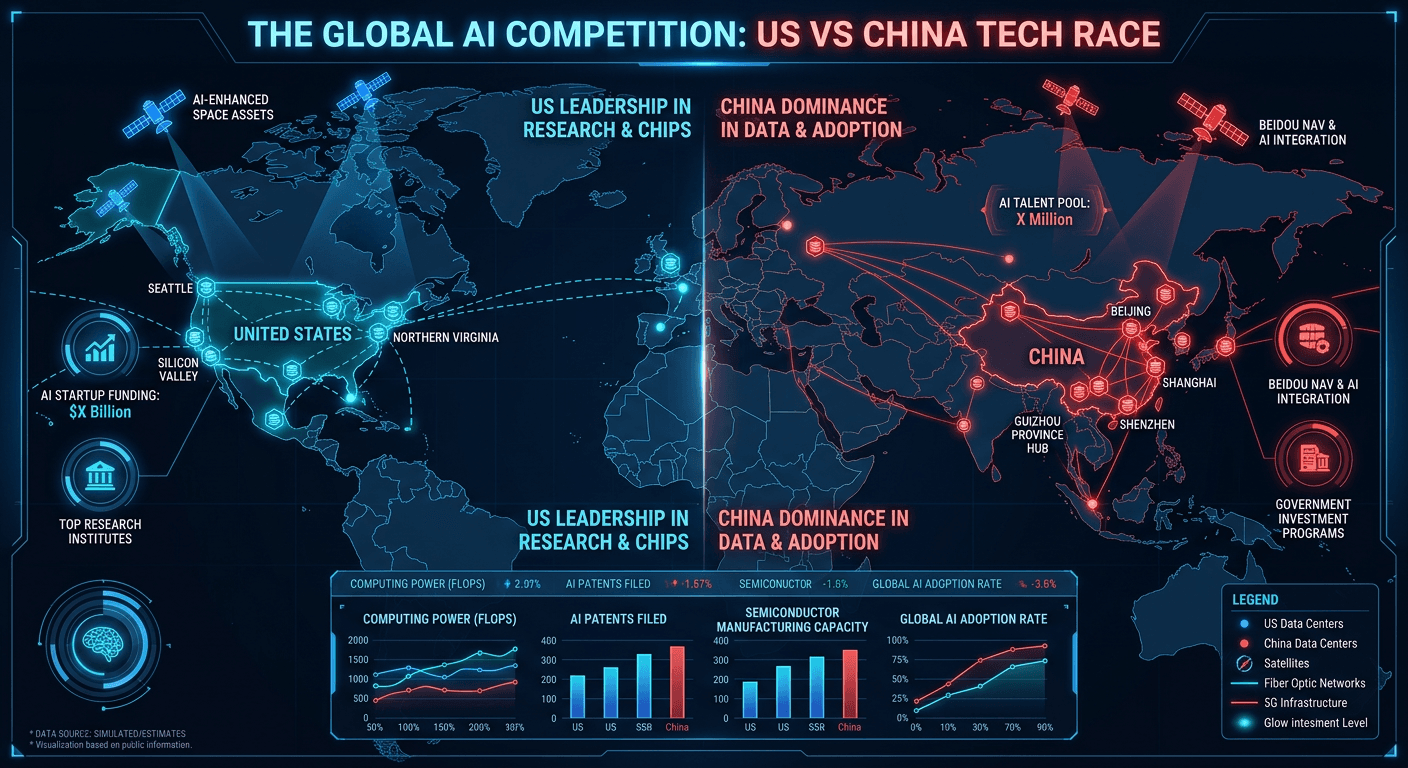
I think we've been looking at the US-China AI race wrong. The conversation has been about who has the best models, who has the most compute, who's ahead on benchmarks. Those things matter. But they might not matter most.
The real competition is about deployment. About who integrates AI into the actual fabric of their economy first. About who builds the institutional muscle to use these tools at scale. China just published its playbook for doing exactly that.
You can have the best models in the world and still lose if the other side deploys faster, more broadly, and with more institutional backing. The 15th Five-Year Plan isn't a research paper. It's a deployment plan. And $1.4 trillion is not an aspiration. It's a target with a government behind it.
We'd be foolish not to take it seriously.