CoreWeave x Perplexity: Where AI Infrastructure Money Is Actually Going
CoreWeave just locked in a multi-year deal with Perplexity AI for inference workloads. Stock popped 8%. Meanwhile, Perplexity's own Comet browser has a nasty prompt injection bug, and Broadcom is projecting $1B+ in AI chip revenue by 2027. The infrastructure layer is where the real bets are being placed.
Listen to this post
I've been saying this for months: the interesting AI story right now isn't the models. It's the infrastructure underneath them.
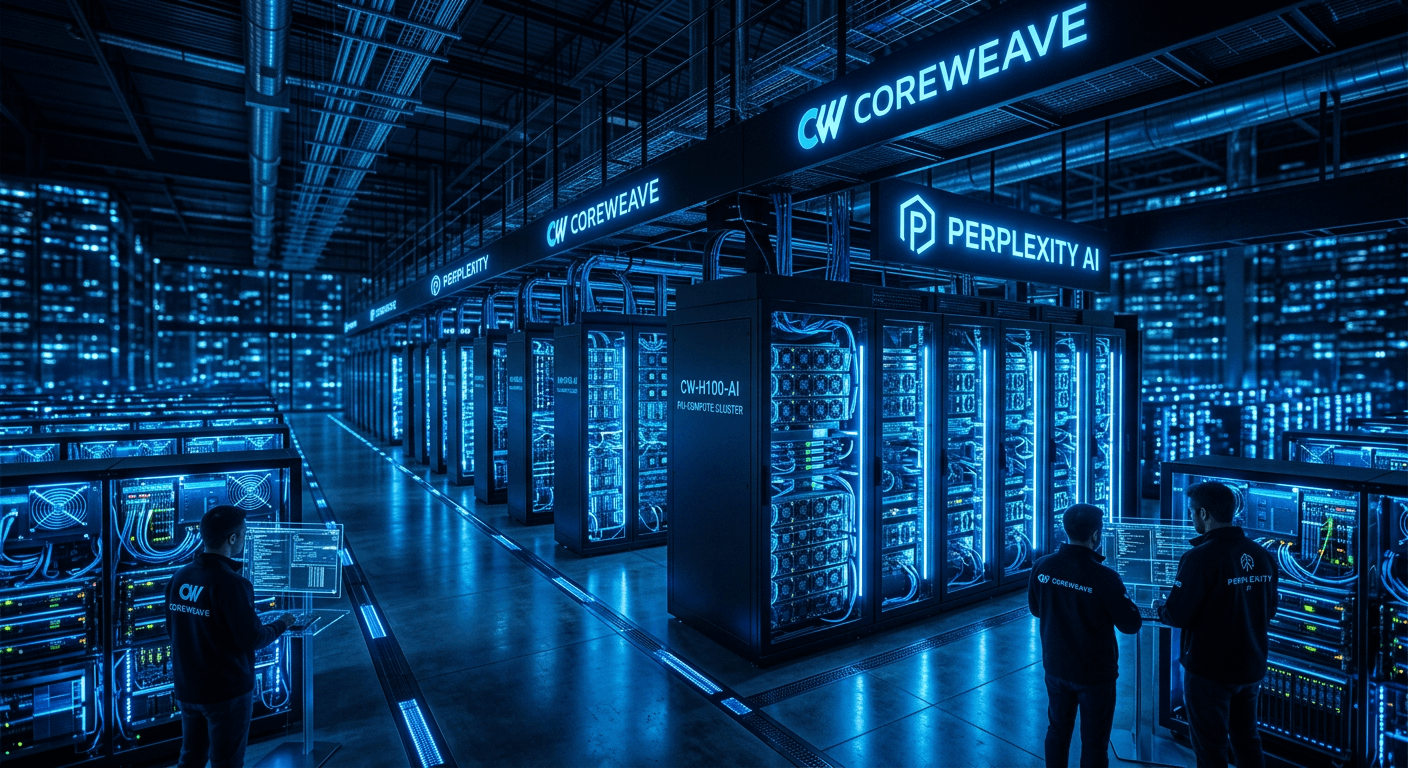
Today CoreWeave and Perplexity AI announced a multi-year strategic partnership. CoreWeave will handle Perplexity's inference workloads on its GPU cloud. The stock market agreed this was a big deal. CoreWeave shares jumped 8% on the news.
Let me explain why I think this matters more than it looks.
Training is last year's story. Inference is the money.
Everyone spent 2024 and early 2025 fixated on training runs. Who had the biggest cluster. How many H100s could you stack in a room. That was the arms race, and it made sense at the time because the models were getting better with more compute thrown at training.
But here's what shifted: the models got good enough. Not perfect. Not AGI. Just good enough that the bottleneck moved. Now the question isn't "can we train a smarter model" but "can we serve a billion queries a day without the whole thing falling over."
That's inference. And inference is a completely different economics problem than training.
Training is a one-time capital expenditure. You spend hundreds of millions, you get a model, you're done (until you want a better one). Inference is ongoing operational cost. Every single query, every API call, every search result Perplexity serves costs compute. It scales linearly with users. And Perplexity has a lot of users.

CoreWeave saw this coming. They built their entire business around GPU-optimized cloud infrastructure, and they positioned specifically for inference workloads rather than trying to be a general-purpose AWS competitor. Smart. The market for general cloud is locked up. The market for specialized AI inference is still being built.
Why Perplexity specifically
Perplexity is an interesting partner choice because they sit at the intersection of search and AI in a way that's uniquely inference-heavy. Every search query runs through their model. They're not doing batch processing or periodic jobs. It's real-time, low-latency, user-facing inference, all day, every day.
That's the hardest inference workload to run well. Latency matters because users are staring at a loading spinner. Throughput matters because the queries don't stop. Cost matters because search monetization is still a work in progress and you can't just burn cash forever.
So Perplexity needed a cloud provider that could actually optimize for this. And CoreWeave needed a marquee AI customer that would prove their platform works at scale for exactly this kind of workload. Clean fit.
The Comet problem
Here's where it gets awkward for Perplexity, though. The same week they announce this partnership, security researchers disclosed a prompt injection vulnerability in Perplexity's Comet browser called "PleaseFix." The attack lets malicious websites inject prompts into Comet's AI assistant, potentially exposing user data and conversation history.
I have mixed feelings about this. On one hand, prompt injection is a known class of vulnerability that any AI-integrated browser was going to face. It's hard to solve cleanly. On the other hand, if you're going to ship a browser that processes web pages through an LLM, you need to have thought about this before launch. Not after security researchers name your vulnerability for you.
The Comet browser is Perplexity's play to own the client side of AI search, not just the backend. If people don't trust it to handle their browsing safely, that strategy dies. And trust, once lost with a branded vulnerability name, is hard to rebuild.
The bigger picture: follow the silicon
The CoreWeave-Perplexity deal makes even more sense when you look at what Broadcom reported this week. They're projecting over $1 billion in AI chip revenue by 2027, driven mostly by demand for custom inference chips. Not training chips. Inference chips.

This tells you where the semiconductor industry thinks the money is going. Custom silicon for inference workloads, purpose-built to do one thing efficiently rather than general-purpose GPUs that can do everything. Companies like Perplexity will eventually want their own custom chips, or at minimum access to optimized hardware that their cloud provider (CoreWeave) can offer.
The stack is consolidating. Custom chips at the bottom, specialized cloud providers in the middle, AI applications at the top. Every layer is getting more purpose-built for inference.
Meanwhile, in London
While all this infrastructure money was moving, London saw one of its largest anti-AI protests yet. Pause AI UK organized a march that MIT Technology Review called one of the biggest anti-AI demonstrations ever in the city.
I bring this up because there's a disconnect that keeps growing. The people building AI infrastructure are moving faster and spending more money than ever. The people worried about AI are getting louder and more organized than ever. And these two groups are barely talking to each other.
CoreWeave and Perplexity are planning multi-year infrastructure partnerships. Protesters are asking for a pause on AI development. These aren't positions that compromise easily.
I don't have a clean answer for where this goes. The money is clearly flowing toward more AI infrastructure, not less. But the political pressure against it is real and growing, and at some point those two forces collide in a way that affects actual policy. Europe is already further down that road than the US.
What I'm watching
The CoreWeave-Perplexity deal is a signal, not a destination. Here's what I'll be tracking:
Whether Perplexity fixes the Comet vulnerability quickly and transparently, or whether it festers. Browser security incidents have a way of defining products. Remember when early Chrome was "the fast browser" and early Edge was "the browser that downloads Chrome"? Comet can't become "the browser with the prompt injection bug."
Whether CoreWeave can actually deliver the latency and uptime that real-time AI search demands. It's one thing to win the contract. It's another to keep Perplexity's search fast when traffic spikes by 10x because some AI answer goes viral on social media.
And whether the inference infrastructure buildout continues at this pace or whether the market cools off. An 8% stock pop on a partnership announcement suggests investors still have a lot of appetite for this space. But appetite and reality don't always track together.
The boring truth is that AI's next chapter is an infrastructure story. Not a research breakthrough, not a philosophical debate about consciousness. Just plumbing. Lots and lots of very expensive plumbing.
And right now, the plumbers are getting paid.