A B300 Server Now Costs a Million Dollars in China. That's the Story.
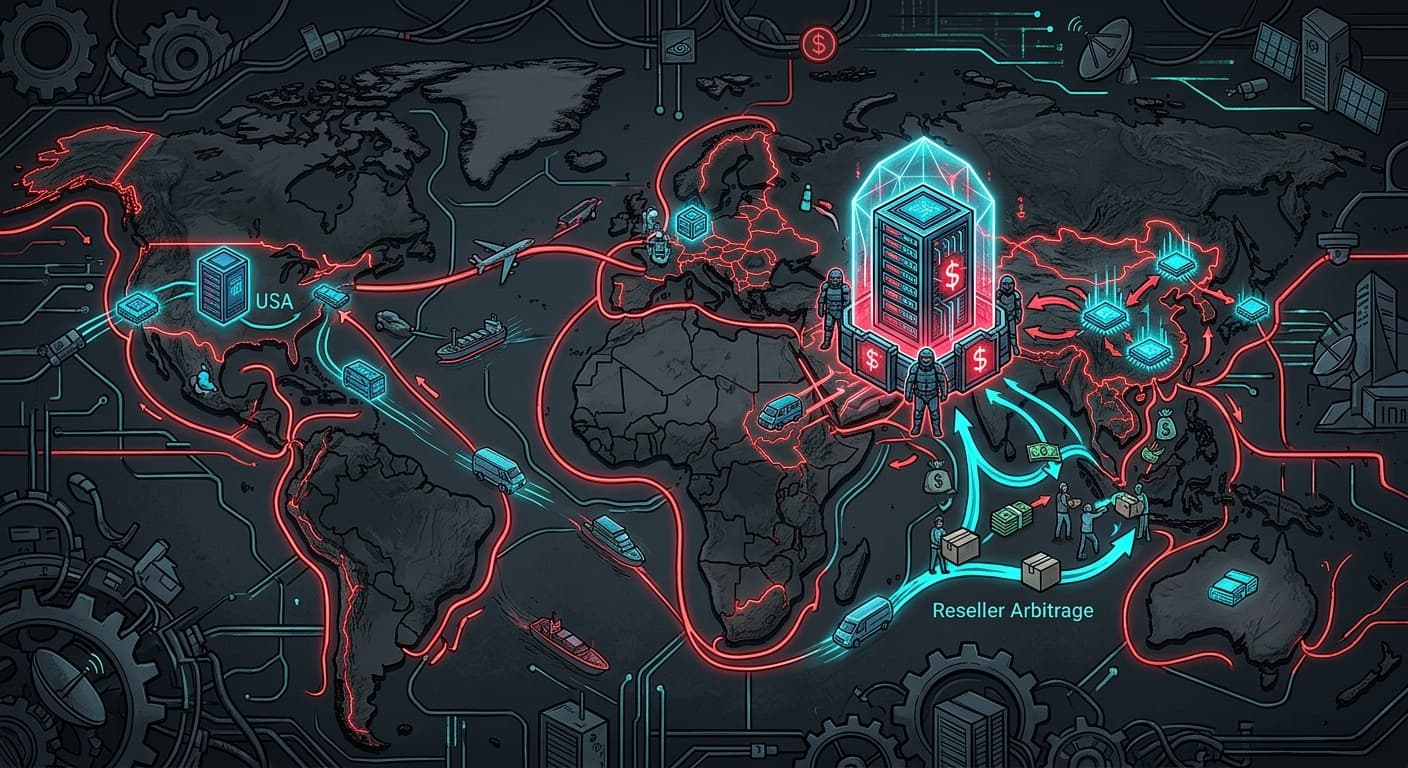
Nvidia's B300 server is going for around 7 million yuan in China, roughly $1 million, almost double the U.S. price. The grey market got squeezed, the price doubled, and rentals are running at 190,000 yuan a month. This is what compute looks like when it becomes contraband.
Listen to this post
Reuters dropped a number this morning that I have not been able to stop thinking about. Nvidia's B300 server is selling in China for about 7 million yuan. That's roughly $1 million. The same machine in the U.S. goes for around $550,000.
A B300 server is eight B300 GPUs in a box. 288 GB of high-bandwidth memory per chip. 14 petaFLOPS at FP4. Nvidia and partners like Supermicro started shipping these things last September. They are not legal to sell in China. Reuters quotes Nvidia directly: the B300 is restricted from sale there, and the company called unlawful diversion "a recipe for failure."
Late last year these same servers were going for about 4 million yuan in China. In a few months the price has nearly doubled. And the U.S. price has only nudged up from about $500,000 to $550,000 over the same window. That gap is not a market gap. It is a smuggling tax.
What actually changed
The grey market is what changed. Reuters reports the recent price spike accelerated after Chinese authorities cracked down on chip smuggling, which had been a key supply channel into the country. So you have a market where:
- The legal channel was already closed by U.S. export curbs
- The grey channel was the main route
- The grey channel got squeezed
- Demand kept rising
That is the entire setup. Anybody who has watched a black market for any other restricted good knows what comes next. Prices spike, smaller buyers get priced out, and rentals appear. Reuters confirmed that part too. Companies that can't afford to buy are paying as much as 190,000 yuan a month for short-term, one-year rental contracts on these systems. That's roughly $26,000 a month for time on a machine you don't own and your name probably isn't on.
There's a related detail in the Reuters piece that I think is the most underrated part of the story. Some Chinese firms are deliberately not putting Nvidia hardware on their books. They're using it. They just aren't carrying it as an asset, because doing so would expose them to U.S. sanctions risk. So the actual install base of B300s in China is undercounted by definition. We are talking about a market where the buyers are obscured, the sellers are illegal, the prices are double, and the asset doesn't show up on the balance sheet. That is not a normal hardware market. That is a contraband market with a cooling system.
Why the demand isn't slowing down
This is where the story gets uncomfortable for the people who think export controls are a clean tool.
Morgan Stanley says Chinese AI models climbed to 32% of global token usage in March 2026, up from 5% a year earlier. Reuters cites MiniMax, Zhipu, and Alibaba's Qwen as seeing token usage rise sixfold to sevenfold in February and March compared to December. Whatever you think about Chinese AI model quality, the usage curve is real, and usage requires inference, and inference requires chips.
The export controls were supposed to slow Chinese AI development. What's actually happened is the demand for top-end Nvidia hardware has gone up while the legal route to get it has been closed. So the grey market expanded. The grey market got policed. The price doubled. And the people who can pay $1 million a server keep buying, because the alternative is falling behind in a market where token usage just sextupled in two months.
Nvidia still has about 55% market share in China per the Reuters reporting. AMD has about 4%. Huawei and the rest of the Chinese chipmakers are pushing hard to fill the gap, and they will eventually fill some of it. But not enough, fast enough, to absorb a sevenfold demand spike. So the squeeze keeps tightening, and the price keeps reflecting that.
There's also the H200 question hanging over this. Reuters notes that uncertainty around whether H200 exports to China will continue is also fueling demand. If you're a Chinese AI company sitting on a roadmap that depends on H200s, and you're watching the policy noise around them, you start hoarding B300s as a hedge. That is also reflected in the price.

The part nobody is saying out loud
When a Nvidia server costs a million dollars in one country and half a million in another, you have stopped pricing a piece of hardware. You have started pricing access to a kind of national capability.
I think people are still framing this as a chip story. It is not really a chip story. It is a story about whether AI compute is a normal traded good or a strategic resource that follows the same rules as other strategic resources. We have answered that question, more or less, by accident. The U.S. has made compute a controlled export. China has made it a strategic priority. The grey market filled the gap and got policed. The price went vertical.
The same pattern played out with enriched uranium, with certain semiconductor lithography tools, with specific aerospace components. Strategic restriction plus structural demand equals a price that has nothing to do with the cost of production. The B300's cost-to-build is not 7 million yuan. It is not even close. The 7 million yuan number is a geopolitical number with a tape-out cost embedded in it.
Nvidia's official position is that the company doesn't service or support these diverted machines and that "enforcement mechanisms are rigorous and effective." That's the legally correct thing to say. It's also a tell. Nvidia knows perfectly well that machines with its name on them are running in Chinese data centers right now. The company's exposure is that it can't be seen knowing, can't be seen helping, and can't be seen profiting from the diversion. So it has to publicly distance itself from the very units that are propping up its 55% market share in a country it can't legally sell to.
That is a strange business posture and it should make people pause. The largest AI hardware company in the world is operating in a market where its own product is contraband, and it has to actively disavow the channel keeping its share intact.

Who actually wins from this
Short term, the smugglers and the resellers win. They always do in a setup like this. Doubling prices in six months is a ridiculous return for whoever is moving the boxes through whatever third-country reroute is currently working.
Medium term, Huawei wins. Not because Huawei chips are as good as a B300. They aren't, not yet. But because every Chinese AI company that pays a million dollars for a B300 today is going to be a lot more receptive to a Huawei sales pitch tomorrow. The export controls plus the grey market squeeze are doing more to accelerate Chinese domestic chip adoption than any subsidy program could. If you raise the price of the foreign substitute high enough, the domestic substitute starts looking reasonable even if it's slower. That's how import substitution works historically and it's how it's going to work here.
Long term, I genuinely don't know. I keep trying to figure out whether the export control regime, in its current form, is slowing Chinese AI development or just making it more expensive while it continues at the same rate. The token usage numbers suggest the latter. The grey market squeeze suggests the U.S. is at least raising the cost. Both can be true. Whether that's a good trade depends on what you think the goal was, and I'm not sure the people who designed the policy had a single goal.
What I'd watch next
The 7 million yuan number is the headline, but it's not the most important number in the Reuters piece. The most important number is the 32% Morgan Stanley figure. If Chinese AI models are now generating roughly a third of global tokens, then the question of who controls the compute under those models becomes a strategic concern that's bigger than any single export control rule. You don't get to decide that one country handles a third of the world's AI inference and also that you're going to control the hardware running it. You can have one or the other.
The next chapter of this story is whether the grey market crackdown holds, whether the B300 price keeps climbing or settles, and whether one of the Chinese chipmakers actually delivers a credible alternative inside the next year. If Huawei or somebody else ships something good enough at half the price, the B300 premium collapses overnight. If they don't, the premium keeps growing, and so does the gap between what the policy was supposed to do and what it actually does.
A million-dollar server is a number you remember. The reason it costs that much is the part that matters.