Musk vs OpenAI Hits the Stand. The Real Defendant Is the Nonprofit Story.
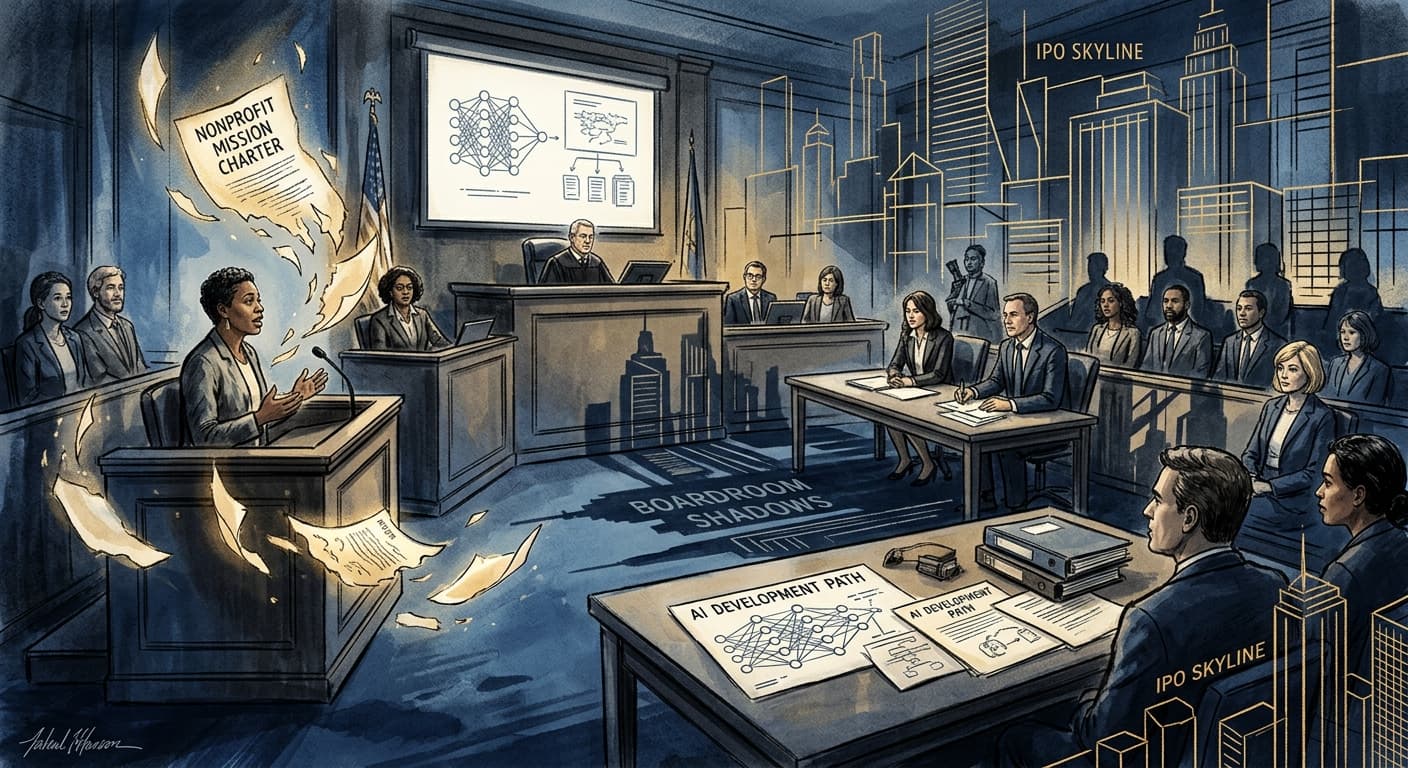
Musk took the stand in Oakland on Tuesday and called OpenAI a looted charity. OpenAI's lawyer called him a sore loser who wanted the keys to the kingdom. Both can be true. The interesting part is what the trial does to OpenAI's IPO, Microsoft's grip on the deal, and the safety story OpenAI has been telling itself for a decade.
Listen to this post
The Musk-OpenAI trial opened in Oakland on Tuesday and Musk took the stand the same day. Reuters covered it from the courthouse. The opening sentence of his testimony was basically the entire complaint compressed: "If we make it OK to loot a charity, the entire foundation of charitable giving in America will be destroyed. That's my concern."
OpenAI's lawyer, William Savitt, took the other side just as bluntly. "What he cares about is Elon Musk being on top," Savitt told the jury. "We are here because Mr. Musk didn't get his way."
Both lines are doing real work. Musk wants the case framed as a moral fight about whether the original 2015 charter survives. OpenAI wants the case framed as a personal grievance from a co-founder who lost a power struggle and is now $150 billion sore about it. The jury is going to pick one of those two stories. So is the public.
Here's what I want to get to: the trial isn't really about Musk. The trial is about whether the OpenAI-as-nonprofit story can survive cross-examination, and what it costs OpenAI when that story stops being a marketing line and becomes a contested fact.
What Musk is actually asking for
The remedies he's seeking are not symbolic. From the Reuters write-up: $150 billion in damages directed at OpenAI's charitable arm, a forced reversion of the company to nonprofit control, and the removal of Sam Altman and Greg Brockman as officers, with Altman also removed from the board. CNBC adds that Musk earlier in the litigation had asked for as much as $134 billion personally. He dropped that. The current ask routes the money to the charity.
That second framing change matters. By directing damages to the nonprofit, Musk is making it harder for OpenAI to characterize this as personal enrichment, which was Savitt's whole opening. He's also boxing the jury into a moral frame: either you think the 2019 for-profit conversion was a legitimate restructuring of a research lab that needed compute and talent, or you think it was a charitable trust being repurposed into one of the most valuable private companies on earth.
The legal claims are breach of charitable trust and unjust enrichment. Both are old, well-developed doctrines. They're also exactly the doctrines you'd reach for if you wanted to argue that a 501(c)(3)-adjacent mission can't be silently rewritten by the people who were supposed to be its stewards.
The OpenAI defense, decoded
Savitt's argument has two parts. The first is character: Musk wanted control, didn't get it, started xAI, sued. The second is necessity: the 2019 for-profit subsidiary was the only way OpenAI could buy compute and pay scientists who were being recruited by Google's DeepMind. The Reuters piece quotes Savitt framing the for-profit creation as "critical to letting it buy computing power and pay top scientists to stay competitive."
This necessity argument is the load-bearing wall of OpenAI's defense, and it's the part I think a lot of people are not weighing carefully enough. If the jury accepts that the only way to pursue the charitable mission was to create a structure that could raise tens of billions of dollars from Microsoft and others, then the mission and the conversion are not in conflict. They become the same thing. The for-profit was a means; the mission was the end.
The problem with that argument is that OpenAI is now worth more than $850 billion, has a public benefit corporation structure, and is reportedly preparing for an IPO at a valuation up to $1 trillion. At some point the means and the end become hard to tell apart, and the "we needed to do this to fund the mission" defense starts to look like a description of every for-profit company that has ever existed.
OpenAI's structure today, per Reuters: public benefit corporation, with the nonprofit holding a 26% stake plus warrants tied to valuation targets. That is not zero. It is also not the original promise. Whether the jury sees that as a reasonable compromise or as a structural sleight of hand is going to come down to how the witnesses, including Altman and Satya Nadella, hold up under cross.
The Microsoft shadow
Microsoft put $10 billion into OpenAI in January 2023. Musk's lawyer Steven Molo flagged that figure in his opening, and Microsoft's lawyer Russell Cohen responded that Microsoft had been "a responsible partner every step of the way." That's the position Microsoft has to hold publicly, and it's the position that's going to get tested across the entire trial.
Two days ago I wrote about Microsoft and OpenAI renegotiating their pact, removing the AGI clause that would have let OpenAI walk away from Microsoft's revenue share, in exchange for Microsoft giving up exclusivity. The timing of that renegotiation, two days before this trial opened, is not subtle. Microsoft has been quietly cleaning up the legal and structural surface of its OpenAI relationship for months. The exclusivity end. The AGI rider removal. The 20% revenue cap. All of it pointing toward a future where Microsoft can stand in front of a jury, a regulator, or an IPO prospectus and say: we are an investor and partner, we are not a controlling owner, we did not extract the charity.
The trial is going to make Microsoft sit in that position publicly. Nadella is on the witness list. He is going to be asked, under oath, about how Microsoft's $10 billion changed OpenAI's trajectory and how much influence the company exerted on the structure that's now being challenged. Whatever he says is going to feed straight into both the antitrust files in Brussels and Washington and the IPO disclosures.
The safety problem nobody wants to argue about in public
This is the part of the trial I find most uncomfortable, in a useful way.
Musk testified that he founded OpenAI as a counterweight to Google after his AI safety arguments with Larry Page went nowhere. CNBC reported that part. He also, per NPR, warned about what he called a "Terminator outcome." OpenAI's response, through Savitt, was that AI safety was not actually a priority for Musk and that he called the OpenAI employees who focused on it "jackasses."
These are not statements that can both be true the way they're being used. They can both be partially true, which is probably the actual answer. Musk talks about AI safety constantly and also, demonstrably, ran his own AI company through a regulatory and content-moderation posture that very few safety researchers would describe as cautious. OpenAI was founded with safety language baked into its charter and now ships frontier models on an aggressive cadence with a safety culture that has lost more than one prominent researcher in protest.
What the trial does is force both sides to argue in public about what AI safety actually meant inside OpenAI between 2015 and 2019, and whether the for-profit conversion changed that. That conversation is going to be ugly. Internal emails are going to come out. Slack screenshots are going to come out. People who have not been quoted publicly are going to give depositions that get read into the record. There is no version of this trial where the AI safety story OpenAI has told the public for a decade survives intact. Either it gets validated and Musk loses, or it gets gutted and the verdict becomes a footnote next to the public record of the depositions.
What this does to the IPO
The Reuters piece notes that the trial "could complicate OpenAI's IPO plans and intensify Americans' fears about AI technology more broadly." That sentence is doing more work than it looks like.
OpenAI is reportedly preparing for an IPO at up to a $1 trillion valuation. SpaceX, also Musk-controlled, is reportedly heading toward what could be the largest IPO ever this year. The Reuters article notes both. The two companies are now racing toward public markets in a moment where AI investor appetite is high and AI regulatory anxiety is also high. That's a very narrow path.
An IPO prospectus that has to disclose ongoing litigation involving claims of breach of charitable trust, with potential remedies including the removal of the CEO and the reversion of the corporate structure to nonprofit control, is not a clean prospectus. Even if the jury rules entirely in OpenAI's favor, the trial record itself becomes part of the public file that institutional buyers will read. The S&P 500-style fund flow that OpenAI is going to want is going to require risk factors that did not exist a month ago.
There's a subtler version of this too. The reason for the for-profit conversion, per OpenAI's defense, was the need to compete with Google for compute and talent. That argument also describes the IPO. The IPO is the next iteration of the same logic: we need bigger pools of capital to keep pace, therefore we have to sit further along the for-profit spectrum than we used to. If the jury buys the necessity argument for 2019, OpenAI gets to use the same argument for the IPO. If the jury rejects it, the IPO gets a new and very serious headwind.
The judge already lost patience with one of these guys
Worth flagging. Judge Yvonne Gonzalez Rogers admonished Musk before jury selection over his X posts about Altman, where he called him "Scam Altman" and accused him of stealing a charity. Per Reuters, Rogers said she was "loath to issue a gag order" but told Musk to "try to control your propensity to use social media to make things work outside the courtroom."
Then she added the line that I think is the funniest sentence in the trial coverage so far: "Perhaps you've never done that before."
Both Musk and Altman agreed to minimize their social media activity for the duration. We will see how that holds. The judge's posture matters not just for the trial dynamics but for how the jury reads Musk as a witness. He's already been told, on day one, to behave. That is not a neutral fact when his entire case rests on the jury believing him as a steward of the original mission.
What the verdict actually changes
Reuters notes that a verdict is possible by mid-May. That's a tight window for a case this big.
Three rough scenarios.
If Musk wins on the charitable trust claim and the court orders structural remedies, OpenAI as a corporate entity is in a different posture than it has been in for seven years. The IPO timeline gets pushed. Microsoft's deal terms get re-examined. The 26% nonprofit stake potentially expands. Altman's role becomes a question rather than an assumption. None of this is impossible to recover from, but the next twelve months become reorganizational rather than expansionary.
If OpenAI wins cleanly, the for-profit conversion gets a court-validated stamp of legitimacy, the IPO narrative gets a useful piece of evidence ("a federal jury rejected the claim that this restructuring violated the original mission"), and Musk's effort to rewrite OpenAI's founding story formally fails. The bigger AI-safety conversation continues outside the courtroom, but loses one of its most visible legal entry points.
If the result is partial (damages without structural relief, or relief without damages, or a split verdict on the various claims), then both sides claim a partial win and the underlying questions about whether OpenAI's nonprofit DNA still exists in any meaningful sense get pushed to the next forum. Probably regulators. Probably the IPO disclosures themselves.
What I keep coming back to
There's a version of this trial where Musk is mostly right about the structural drift, mostly wrong about being the right person to fix it, and where OpenAI is mostly right that the conversion was operationally necessary, mostly wrong that it preserved the charitable mission in any recognizable form. That version is the one I think is closest to true, and it's the version that has no clean legal answer.
The honest read of the public record is that OpenAI in 2026 is not the OpenAI that was announced in 2015. The 26% nonprofit stake is real. The PBC structure is real. The mission language in the charter still exists. But the company that's about to file for an IPO at up to a trillion-dollar valuation, with $250 billion in Azure commitments, $10 billion of Microsoft's money, a public benefit corporation structure, and a CEO who survived being fired and reinstated by his own board inside a 96-hour window in 2023, is not legibly continuous with the research-lab-in-an-apartment that Brockman and Musk and Altman started ten years ago.
The trial is going to make somebody say that on the record, in front of a jury. That's the part the IPO prospectus can't quite plan for.